
If you have been feeling like the Canadian economy is stuck in second gear, you aren’t imagining things. We are living through what economists politely call a “productivity crisis,” accompanied by a stagnation in our average standard of living.
For those of us on the ground—freelancers, agency owners, and independent consultants—this isn’t just a macroeconomic headline. It’s the reality of working harder for dollars that don’t stretch as far as they used to.
I recently spent some time with a comprehensive new report titled Building Canada’s Brightest AI Future by Deloitte. It is a dense, rigorous look at where our country stands on the global technology stage. While the report is written for policymakers and enterprise CEOs, there is a subtext screaming out from the pages that I believe is actually addressed to you—the Canadian solopreneur.
The report identifies a critical flaw in our national business machinery. It’s not a lack of talent; we have world-renowned researchers and an impressive talent pool. It’s not a lack of government funding; billions have been earmarked for infrastructure.
The problem is what the report calls an “ambition problem”.
Specifically, Canada is suffering from a risk-averse culture. While the rest of the world is racing to adopt new tools to become more efficient, Canadian businesses are stuck in a “wait-and-see” approach.
But here is my thesis for 2026: Big business might be waiting, but you don’t have to.
The “Wait and See” Trap
The Deloitte findings paint a frustrating picture of the corporate landscape. In the US, companies are diving into AI and automation. They pick a use case, launch it, and fix the governance along the way because they prioritize ROI above all else.
In Canada? We hesitate.
Canadian companies are happy to educate their boards and write policy papers, but “as soon as you go to developing and integrating a solution, everything just stops”. It takes, on average, 18 months to start building an AI product in Canada, compared to just four months in the United States.
This hesitation is creating an “Ambition Gap.”
We are collectively paralyzed by the fear of getting it wrong. We analyze, we plan, we committee-meeting ourselves to death. And while we are “waiting to be forced to do it,” our global competitors are pulling ahead.
For a large corporation, this sluggishness is a strategic error. For a solopreneur, it is an opportunity.
The Solopreneur’s Advantage: Agility as a Superpower
As a small business owner, you possess the one asset that the big banks and telecom giants effectively lost years ago: Agility.
You do not have a Board of Directors that needs to sign off on a new software subscription. You do not have a procurement department that takes six months to approve a new workflow. You are the CEO, the CFO, and the IT department wrapped into one.
The Deloitte report suggests that if Canada fully adopts AI, our real GDP could be 5% to 8% higher in the next 10 years.
Translate that to your business. What would your life look like if your personal “GDP”—your revenue and output—increased by 8% not because you worked more hours, but because you worked better?
To achieve this, we have to reject the national mood of risk aversion. We have to stop “waiting and seeing” and start “defining ambition”.
What “Defining Ambition” Looks Like for Us
The report outlines a framework for success that starts with “Ambition.” It defines this as a “visionary mindset with a sharp focus on creating value”.
For the Fortune 500, this means billion-dollar R&D budgets. For the “Fortune 1” (that’s you), it means ruthlessly eliminating the low-value work that clogs your day.
We often confuse “busyness” with “business.” We spend hours categorizing expenses, chasing invoices, trying to predict our tax bills, and organizing client data. We feel productive because we are tired at the end of the day. But are we creating value?
True ambition in 2026 means automating the survival tasks so you can focus on the growth tasks. It means looking at your operations and asking, “Why am I doing this manually when the technology exists to do it instantly?”
Turning Technology into Infrastructure
This is where the conversation usually pivots to buying a dozen different AI tools—a chatbot for this, a writer for that. But that leads to subscription fatigue, not productivity.
The report highlights that for AI to work, it needs to be sustainable and scalable. It’s not about flashy experiments; it’s about integrating intelligence into the bedrock of your business.
This philosophy is exactly what drove the architecture of Gestora OS.
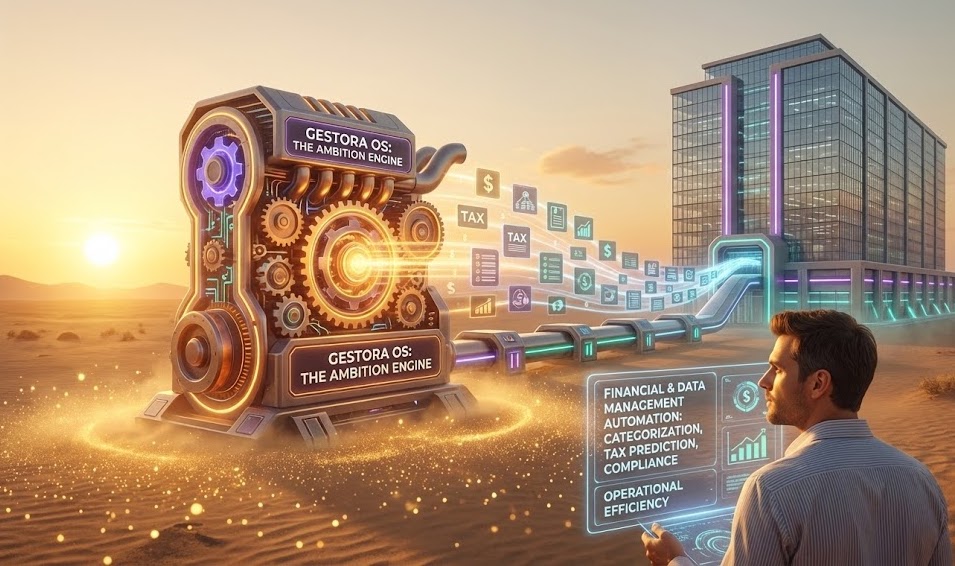
When we looked at the landscape of financial tools available to Canadian small businesses, we saw the same “wait and see” hesitation the report describes. Most tools were just digital versions of paper ledgers—passive, reactive, and requiring heavy manual input.
We decided to build something for the ambitious.
We designed Gestora OS to be the “Ambition Engine” for your business. We realized that if we could automate the financial and data management layer—the categorization, the tax prediction, the compliance—we could give solopreneurs the same operational efficiency as a large enterprise.
- We focused on Value Creation: The report urges leaders to define ambition with a relentless focus on value. Gestora OS automates the data entry so your focus remains 100% on your clients and your craft.
- We removed the Lag: Remember that 18-month vs. 4-month statistic? By integrating advanced financial intelligence directly into your dashboard, we let you skip the R&D phase. You get the benefits of a “smart” finance department immediately, without the wait.
- We embraced the Vision: You have a vision for your business that goes beyond paperwork. Our vision is to be the silent operating system that makes yours possible.
The Window is Closing
There is a sense of urgency in the Deloitte findings. We have a “small window of the next five years or so” where our choices will determine if we lead or fall behind. The risk of “missing the AI wave” is real, just as we missed the Internet wave in the early 2000s.
The economy might be fragile, and the regulations might be complex, but the path forward isn’t to retreat into a shell of caution.
The path forward is to act.
As we head into this new era, let’s leave the “wait and see” attitude to the dinosaurs. Let’s decide that 2026 is the year we stop working for our administration and start making our administration work for us.
Let’s be ambitious.
This is part one of our “Future-Proof” series, breaking down the future of Canadian business technology. Next week, we will tackle the “Glass Box” paradox—why trusting your data is more important than ever.
Leave a Reply