
Author: Vince Prince

  • The Centaur Strategy: Why the Future of Business is Half-Human, Half-Machine

    The Centaur Strategy: Why the Future of Business is Half-Human, Half-Machine

    In the world of ancient mythology, there is no creature quite as striking as the Centaur. With the upper body of a human and the lower body of a horse, it combined human intelligence and spirit with the raw power and speed of a beast. Neither half could achieve on its own what they could accomplish together.

    As we look at the landscape of 2026, I want to propose a new kind of mythology for the Canadian solopreneur: The Centaur Strategy.

    Lately, the conversation around Artificial Intelligence has been polarized. On one side, there is the fear that machines are coming for our jobs. On the other, there is the hollow promise that technology can do everything for us while we sit on a beach. Neither is true.

    The most recent Deloitte study on Canada’s AI future, Building Canada’s Brightest AI Future, introduces a much more grounded and exciting concept: Human-AI Synergy.

    The report argues that the biggest performance improvements don’t come from replacing humans, but from strategic collaboration. It’s about a partnership where AI handles the heavy lifting—the “beast” of data and repetition—so the human “mind” can focus on creativity, empathy, and complex strategy.

    Making Good Workers “Great”

    I love how the report puts it: AI is something that extends our abilities. If you are already a good programmer, writer, or consultant, AI won’t replace you; it will make you great. It amplifies your cognitive strengths and automates the mundane.

    Think about your daily life as a freelancer or small business owner. You are a “one-person show.” You are the CEO making the big decisions, the CMO finding the clients, and the CFO managing the books.

    You don’t need a replacement. You need a clone. You need that “horse half” to handle the miles of administrative terrain so your human half can stay fresh for the finish line.

    A Glimpse into the “Bright Future”

    The Deloitte report illustrates this beautifully through the story of a man named Dev. In a “Bright Future” scenario set in 2030, Dev meets with an AI financial advisor named FIN.

    Dev isn’t just handing over his life savings to a robot and walking away. Instead, he uses FIN to process vast amounts of market trends and policy changes. FIN explains the rationale behind its suggestions in simple terms.

    But here is the most important part of the story: when FIN suggests a new, complex investment opportunity in cryptocurrency, Dev doesn’t just click “buy.” He leans back and contemplates. He decides he needs more time to think it over and asks to schedule a follow-up with a human advisor.

    FIN doesn’t get offended or pushy. It simply arranges the meeting.

    This is synergy. The AI did the data crunching, and the human provided the wisdom and final judgment. Dev ended the call feeling reassured. He had clarity because he was still the one in the driver’s seat.

    The “Centaur” in Your Own Workspace

    For a solopreneur, the Centaur Strategy is about finding your own “FIN.”

    We often spend 60% of our time on what I call “survival tasks”—categorizing receipts, double-checking tax remittances, and organizing marketing data. These are the tasks that drain your battery and rob you of your peace of mind.

    When you operate as a Centaur, you delegate those high-volume, repetitive tasks to a system designed to handle them with machine-like precision.

    Imagine waking up and knowing that your financial data has already been sorted, your tax obligations have been predicted, and your cash flow forecast is ready for review. You aren’t doing the work; you are reviewing the work. You are the strategist. You are the human mind at the top, directing the power underneath.

    This synergy allows you to “punch above your weight class.” It gives a single person the operational horsepower of a ten-person agency.

    How Gestora Becomes Your “FIN”

    This vision of a collaborative, human-centric future is exactly why we built Gestora OS.

    We didn’t want to build a tool that makes decisions for you. We wanted to build the “horse half” of your Centaur business—a powerful, reliable AI Co-Pilot that handles the “beast” of data processing so you don’t have to.

    We focused on creating a platform that offers valuable insights without the noise.

    • The Data “Beast”: Gestora OS excels at processing vast amounts of financial and marketing data. It handles the categorization and organization that usually takes you hours.
    • The Human Mind: We provide you with the clarity you need to make the final call. Our dashboard is designed to be your “FIN,” presenting data in a way that is easy to understand, so you can focus on client relationships and creative strategy.
    • True Peace of Mind: By automating the mundane, we give you your time back. You can move through your day with the confidence that the foundational work is being handled accurately, leaving you free to grow your business.

    Winning the Marathon

    The Deloitte report reminds us that the transition to an AI-powered world is a “marathon, not a sprint”. It requires us to nurture our “timeless human capabilities”—curiosity, creativity, and empathy.

    You were never meant to spend your life as a data entry clerk. You were meant to be a creator, a problem solver, and a leader.

    By embracing the Centaur Strategy, you aren’t giving up your role in your business. You are finally stepping fully into it. You are providing the vision, while your technology provides the path.


  • The Gig Worker’s Spreadsheet Nightmare: How Micro-Business Owners Can Finally Ditch the Sunday Bookkeeping Grind

    The Gig Worker’s Spreadsheet Nightmare: How Micro-Business Owners Can Finally Ditch the Sunday Bookkeeping Grind

    The Gig Worker’s Spreadsheet Nightmare

    Let me tell you a story I’ve been carrying around for a while now — the kind that sticks with you because it’s a little funny, a little painful, and wildly familiar if you’ve ever worked for yourself in Canada.

    A few months back, I bumped into a delivery driver at a Tim Hortons in Scarborough. You know the type — hustling from Uber Eats to DoorDash to Instacart, juggling apps like a pro, sipping cold coffee because the day doesn’t always wait for you to drink it hot.

    We started chatting about earnings because… well, that’s what self-employed people do. We compare notes like hockey fans comparing playoff stats.

    He told me, with this proud little grin, “I track everything in a spreadsheet — income, tips, mileage, gas, even my daily wear-and-tear. Been doing it since 2021.”

    Now, I’m expecting to hear he uses some simple sheet. You know…the usual “Income here, mileage there, total at the bottom.” But no. He opens his laptop and shows me a spreadsheet that looks like it was built by NASA.

    Tabs. Formulas. Nested formulas. Pivot tables. Even a colour-coded “fuel volatility chart.”

    My guy didn’t have a spreadsheet. He had a space program.

    Every Sunday, he’d sit down at his dining table — armed with receipts, screenshots, and that one notebook every gig worker has — you know, the one with coffee stains and the sad little curling sticker on the cover.

    He told me he spent two hours manually crunching numbers. Two hours. Every single week.

    “So… why not automate it?” I ask.

    He shrugged. “It’s not much. I like to know where I stand.”

    And that right there is the trap many Canadian gig workers fall into — thinking their time isn’t expensive just because they’re used to doing everything themselves.

    But here’s the truth we forget when we’re knee-deep in our hustle:

    Your time is money

    And sometimes, the money you’re saving is way less than the money you’re losing.**

    For this driver, two hours every Sunday meant 8 hours a month. That’s a whole shift. That’s grocery money. That’s car payment money. That’s time he could’ve spent with his kids, doing meal prep, catching a game, or — honestly — just breathing.

    So I asked him a simple question: “What’s two hours of your time worth?”

    He didn’t even know. Most gig workers don’t.

    We’re so used to “doing it all” that we forget what we’re actually investing.

    His time was worth more than his bookkeeping. Way more.

    When I showed him the shortcut, the man looked at me like I handed him a lottery ticket

    A smiling man looking at his phone with excitement, raising his fist in celebration after receiving good news.
    That moment when Gestora.ca crunches your numbers in minutes and it feels like you just won the bookkeeping lottery.

    He uploaded his files into Gestora.ca. Ten minutes later — and I mean this literally — he had everything his spreadsheet used to take two hours to produce.

    Totals? Done. Mileage? Calculated. Expense categories? Sorted. Receipts? Filed. Tax-ready numbers? Ready.

    Ten. Minutes.

    He didn’t just save time — he got his Sundays back.

    I swear he looked at me like he just got unexpected EI backpay.

    He said, “So… I can go home now?”

    Buddy, you could go live your life now.

    The Hidden Tax of Self-Employment (No, Not the CRA One)

    If you’re a micro-business owner, freelancer, gig worker, or part-time side hustler, you already know this: Life as a self-employed Canadian is not for the faint of heart.

    You work on days other people rest. You work while it’s snowing sideways. You work when the apps glitch, when the client pays late, when the invoices get ignored, or when your body whispers, “Maybe today we don’t?”

    And despite all that… you still somehow end up wasting hours every month doing bookkeeping the hard way.

    Manual spreadsheets. Lost receipts. Mileage tracking that relies more on memory than math. “Guessing” expenses. Playing “What the hell did I buy at Canadian Tire that day?”

    It’s the invisible tax entrepreneurs pay long before CRA ever gets involved.

    But it doesn’t have to be like that.

    The Sunday Syndrome: Why We Bookkeep at the Worst Possible Time

    Ever notice we do bookkeeping only when we’re too tired to function? Sunday evenings, usually.

    Our brains are running Windows 95 at that point. Slow. Crashing. No updates.

    And yet… that’s when many gig workers choose to tackle their finances.

    Why? Because we spend the week trying to survive the hustle. And then the weekend comes, and life gets loud. Then suddenly it’s Sunday, and we’re racing the clock to stay on top of receipts before we forget them.

    Bookkeeping isn’t hard — it’s just done at the wrong time with the wrong tools.

    The Spreadsheet Illusion: “If It’s Manual, It Must Be More Accurate.”

    This is one of the biggest lies we tell ourselves.

    We think manually entering numbers = more control. More accuracy. More responsibility.

    But manual work is where mistakes actually thrive.

    One skipped kilometre log. One missing gas receipt. One wrong formula. One month where you forget to update something.

    Suddenly your entire year is off.

    Automation doesn’t weaken your control — it protects it.

    The Fear of Letting Go

    Here’s the part people won’t admit:

    Many self-employed Canadians cling to spreadsheets because they’re scared of letting go.

    Not scared of automation… Scared of what automation will reveal.

    Scared to see how much they actually spend on gas. Or parking. Or takeout during long shifts. Or supplies. Or business subscriptions. Or work-related Amazon purchases at 1 a.m.

    Automation doesn’t just organize your numbers. It holds up a mirror.

    But that mirror is what helps you grow.

    Why Tools Like Gestora.ca Matter (Especially in Canada)

    Because Canadian self-employment is a different beast.

    We deal with mileage over snowbanks. We deliver in ice storms. We file GST/HST (or QST, hello Quebec). We handle multi-channel income — apps, cash, direct transfers, e-transfers. We juggle part-time gigs with side hustles. We pivot every month because the cost of living doesn’t take a break.

    And most of us do all this… alone.

    So when a tool steps in and says, “Hey, let me handle the boring parts so you can breathe,” that’s not a luxury — that’s survival.

    Gestora.ca isn’t fancy. It’s not trying to be the next Silicon Valley unicorn. It’s practical. It’s built for normal people who don’t want to spend their evenings googling “how to calculate quarterly GST remittance.”

    It’s built for folks like the delivery driver, and like you, and like millions of Canadians who don’t need more hustle — they need more time.

    He Got His Sundays Back — And So Can You

    When that delivery driver realized he was getting two hours of his life back every week, he said something that stuck with me.

    “Feels like someone just handed me more weekend.”

    More weekend. More rest. More time to live instead of calculate.

    And that — more than any tax tip or expense trick — is the real win.

    Bookkeeping shouldn’t feel like a punishment for being self-employed.

    It should feel like clarity. It should feel like empowerment. It should feel… easy.

    If your spreadsheet looks like it belongs at NASA, or you spend Sundays doing math instead of doing life, you deserve better. You deserve tools made for the pace and chaos of modern self-employment.

    And maybe, just maybe… you deserve your Sundays back too.

  • When My Accountant Ghosted Me: How I Took Control of My Small Business Finances (and My Sanity)

    When My Accountant Ghosted Me: How I Took Control of My Small Business Finances (and My Sanity)

    When My Accountant Ghosted Me

    It was a chilly March morning, the kind where the sun pretends to shine but the air still bites. I had a cup of coffee in one hand and a pit in my stomach. Tax season had arrived — and my accountant had vanished. No replies to my emails, no returned calls, not even a “Hey, I’m swamped.” Just… radio silence.

    If you’ve ever run a small business or freelanced in Canada, you know that feeling — the quiet panic when someone you rely on just disappears. Your receipts are piled higher than Mount Tremblant, CRA deadlines are circling like hawks, and you’re still waiting for someone else to make sense of it all.

    At first, I did what any rational adult would do: I panicked, cursed my luck, and frantically Googled “how to survive tax season without losing your mind.”

    Spoiler: I didn’t. But I did find something better.

    The Wake-Up Call I Didn’t Know I Needed

    See, when you run your own business — whether you’re designing websites, driving Uber, selling coffee, or running a small marketing agency out of your spare room — people always say, “Leave the numbers to the experts.”

    And for a while, that’s comforting advice. You get to focus on your craft, your clients, your next gig. But here’s the kicker: when your “expert” disappears, you realize just how blind you’ve been.

    It’s like driving through a snowstorm with your headlights off. You can still move forward, sure, but you don’t really know where you’re going — or what you might hit along the way.

    That week, as I sat surrounded by crumpled receipts and half-filled spreadsheets, I made a decision: I would never let myself be in that position again.

    Not just because I needed my taxes filed — but because I wanted to understand my business.

    From Chaos to Clarity (With a Little Help)

    I started small. I organized my receipts — yes, the same ones that had been living rent-free in my backpack for months. I opened my business bank account and tried to make sense of my expenses.

    That’s when I stumbled across Gestora.ca — a Canadian platform that helps freelancers, gig workers, and small business owners keep their finances organized without the jargon or sticker shock.

    At first, I thought it was “just another bookkeeping app.” But it wasn’t. It was built for people like us — the ones wearing five hats before lunch. It simplified everything: uploading receipts, seeing expenses in categories, even giving me a clean P&L report I could actually understand.

    Suddenly, I wasn’t waiting for an accountant to tell me if I was profitable. I could see it myself. That was the moment I realized that financial clarity isn’t about having a degree in accounting — it’s about visibility.

    And that visibility changes everything.

    The Empowerment Shift

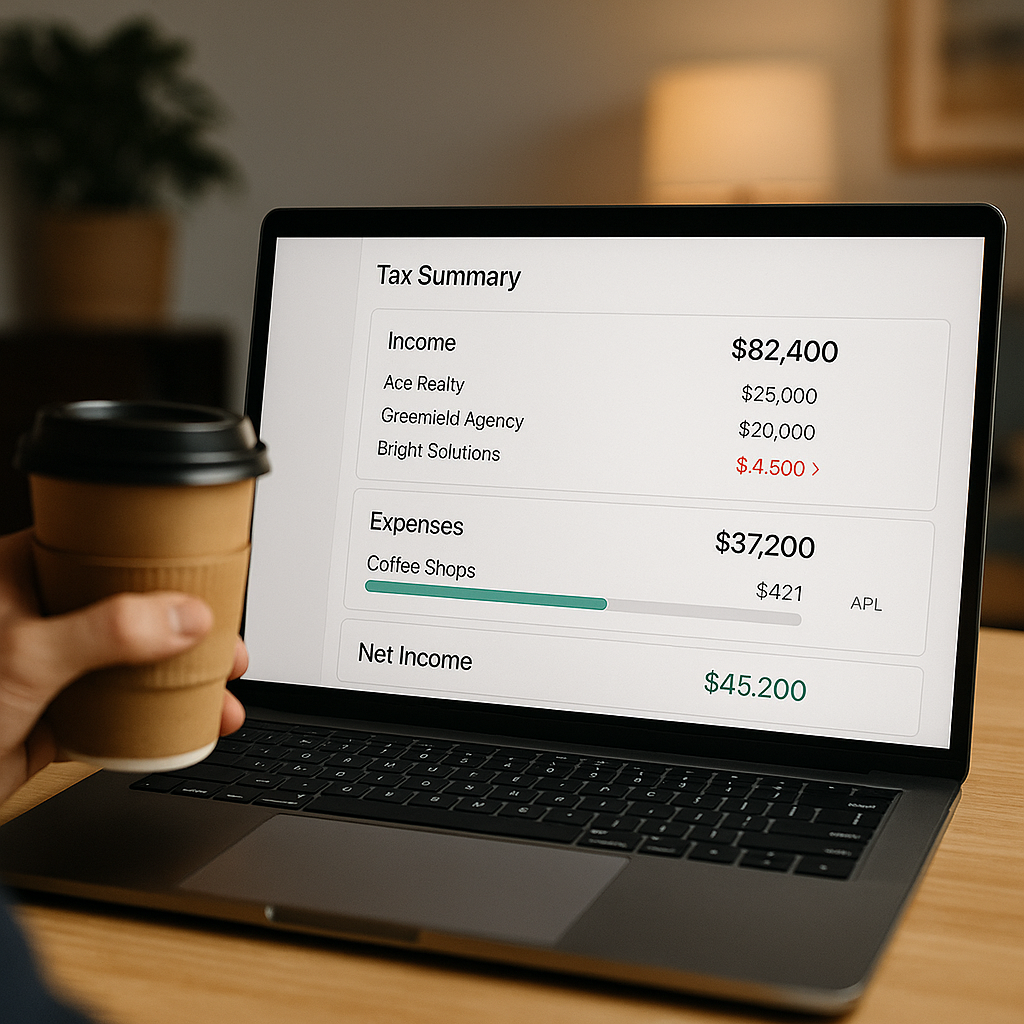
    A close-up of a laptop displaying a financial dashboard with income, expenses, and net income while a person holds a takeaway coffee cup, symbolizing a small business owner analyzing spending habits and business finances in a cozy workspace.
    That moment you realize your “small” coffee habit adds up faster than your clients pay — knowing your numbers means making smarter choices.

    Knowing your numbers doesn’t just help you file taxes; it helps you make better choices. I could finally see which clients paid late (and which ones I should gently fire). I could track where my money was going — those “harmless” $7 coffee runs were stacking up like bad karma.

    It’s funny how power shows up in small ways. I didn’t become a CPA overnight. But I did become the kind of business owner who could look at a spreadsheet without flinching.

    If you’re a freelancer, gig worker, or small business owner juggling everything from invoices to marketing, this part might hit home: understanding your numbers is freedom. It’s the difference between constantly reacting and finally taking the wheel.

    And trust me, after being ghosted by an accountant, the wheel never felt so good in my hands.

    What I Learned (So You Don’t Have To Panic Like I Did)

    1. Never outsource your understanding. Hire professionals, yes — but don’t hand over your power.
    2. Use simple tools. Platforms like Gestora.ca are designed for Canadians who want to keep things simple and affordable.
    3. Make it a weekly habit. Ten minutes every Friday reviewing your numbers beats ten hours of panic every April.
    4. Know that you’re not alone. Most of us didn’t start our businesses because we love bookkeeping. But getting organized isn’t just about taxes — it’s about peace of mind.

    The Moral of the Story

    When my accountant ghosted me, I thought it was a disaster. But looking back, it was probably the best thing that could’ve happened to my business. It forced me to take control, to see my finances not as a chore but as part of my craft.

    Now, every time I upload a receipt or balance my P&L, I feel something I never expected — confidence.

    So, to all the freelancers, micro-business owners, and gig workers reading this while staring at a mountain of receipts: don’t wait for someone else to save you from the chaos. You’ve got this.

    And if you ever find yourself typing “how to survive tax season without losing your mind” into Google, remember this story — and maybe check out Gestora.ca before your coffee gets cold.