
Author: Team Gestora

  • Optimism is Back, But So Is the Red Tape: Navigating the 2026 Regulatory Landscape

    Optimism is Back, But So Is the Red Tape: Navigating the 2026 Regulatory Landscape

    As we close out 2025, there is a palpable sense of resilience in the air. I’ve been speaking with many of you in our community—from the coffee shop owners in Vancouver to the freelance graphic designers in Halifax—and the sentiment matches what the data is finally showing.

    According to the latest findings from the Canadian Federation of Independent Business (CFIB), small business optimism is rebounding as we head into the new year. Long-term confidence has climbed to 59.9, hitting a year-long high that sits just shy of the historical average.

    That is the good news. We have weathered the “rollercoaster” of 2025. But as any seasoned entrepreneur knows, optimism doesn’t pay the bills—and right now, those bills are coming from a very specific, frustrating direction.

    The “Silent” Partner in Your Business

    While we celebrate the uptick in confidence, we have to look at the “fragile” reality underneath. The CFIB’s Chief Economist, Simon Gaudreault, put it perfectly: the headline numbers “don’t tell the full story”.

    The story that isn’t being told enough? The crushing weight of compliance.

    While “insufficient demand” remains a primary barrier for over half of our businesses, the real sting in the tail for 2025 comes from cost constraints. A staggering 62% of small businesses cite tax and regulatory costs as their top cost constraint to end the year.

    Think about that for a moment. It isn’t just the cost of raw materials or rent that is keeping owners up at night; it is the cost of navigating the complex web of government rules and tax obligations. This burden actually ranks higher than wage costs (60%) and insurance (58%).

    The Disproportionate Burden

    Why does this hit us so hard? Because for a solopreneur or a small team, “regulatory compliance” isn’t a department—it’s you.

    Every hour you spend deciphering a new provincial tax rule or organizing receipts for a remittance is an hour you aren’t spending on business development. It is a “time tax” that disproportionately targets the smallest players. While large corporations have dedicated compliance teams, you have late nights and weekends.

    The CFIB report notes that staffing plans remain weak, with more businesses planning to reduce positions than hire. When you are already running lean to survive a “challenging and unpredictable” economic climate, you cannot afford to waste precious manpower on administrative red tape.

    How We Buy Back Your Time in 2026

    t Gestora, our mission has always been to empower the Canadian solopreneur. We believe that technology should be the great equalizer, giving the “little guy” the same data superpowers as the big conglomerates.

    We looked at these cost constraints—specifically that 62% pain point around tax and regulation—and we realized we needed to do more.

    This is exactly why we engineered our new $14.99/month plan.

    We didn’t build this plan just to organize files; we built it to slash the “Tax and Regulatory” burden that is eating into your margins. By automating the collection, categorization, and compliance-readiness of your marketing and financial data, we essentially act as that “compliance department” you thought you couldn’t afford.

    Here is the math:

    • Reduce Professional Fees: By handing your accountant clean, standardized, regulation-ready data, you reduce the billable hours they spend fixing your books.
    • Eliminate Penalties: Accurate, automated tracking means you never miss a regulatory deadline or miscalculate a remittance.
    • Reclaim Productivity: If our tools save you even two hours of administrative work a month, the plan has already paid for itself five times over.

    Looking Ahead

    The economy might still be “fragile heading into 2026”, but your business doesn’t have to be. We can’t control the government’s regulatory changes or the global trade uncertainty, but we can control how efficiently we handle them.

    Let’s make 2026 the year we stop working for our compliance burdens and start making our data work for us.


  • The Blinking Cursor of Doom: How to Beat Content Creation Fatigue Without Burning Out

    The Blinking Cursor of Doom: How to Beat Content Creation Fatigue Without Burning Out

    It’s 2:00 PM on a Tuesday. You’ve got a lukewarm coffee on your desk (perhaps your third of the day), and you’re staring at it.

    The Empty White Page.

    It’s taunting you. That little vertical cursor just keeps blinking. Blink. Blink. Blink. It’s waiting for brilliance. It’s waiting for you to summarize your entire business expertise into a witty, engaging, SEO-optimized, 1000-word masterpiece that will miraculously bring in five new clients by sundown.

    And you? You’ve got nothing. Your brain feels like it’s stuck in a Montreal snowbank—spinning its wheels, making a lot of noise, but going absolutely nowhere.

    If this sounds familiar, welcome to the club. It’s not just you, and you’re certainly not failing. You’re experiencing content creation fatigue, and it is the silent killer of productivity for solopreneurs across Canada.

    The “Good Old Days” Weren’t That Long Ago

    Do you remember when “marketing” meant maybe putting an ad in the local paper, attending a Chamber of Commerce breakfast, or just doing such a good job that word-of-mouth kept you busy?

    “Content is King,” they said. It sounded simple enough. Write a blog post once a week. Share your thoughts.

    But somewhere along the line, the kingdom expanded, and now you’re expected to rule over all of it. Suddenly, you don’t just need a blog post. You need a LinkedIn article (professional tone, please), three clever Instagram captions (don’t forget the hashtags), a relatable TikTok video (hope you know the latest dance trend), and an email newsletter that people actually want to open.

    Oh, and you need to do all of this while actually running your business. You know, the thing that actually pays the bills?

    For the Canadian solopreneur—the corner store owner in Montreal, the graphic designer in Toronto, the realtor in Vancouver, the independent contractor in Halifax—this pressure is immense. You are the CEO, the CFO, the customer service rep, and now, the Chief Marketing Officer. It’s enough to make anyone want to close the laptop and head to the nearest rink for some stress relief.

    An overwhelmed multi-armed solopreneur woman juggling marketing, sales, phone calls, laptop, and calculator, representing small business burnout and content creation fatigue.
    The reality of the modern solopreneur: trying to be the CEO, CFO, and entire marketing department all at once.

    Why the “Empty Page” is So Heavy

    The biggest time-suck for a small business owner usually isn’t fulfilling client work. You’re good at that. That’s your zone of genius.

    The real time-suck is the paralysis of translation. It’s taking that genius in your head and translating it into five different languages for five different platforms.

    It feels heavy because it requires a completely different type of brainpower than your actual work. If you’ve spent four hours deep in client strategy or complex coding, switching gears to “cheery Instagram mode” can feel nearly impossible. Your creative battery is already drained.

    This fatigue leads to a dangerous cycle:

    1. Procrastination: You put off writing because it’s painful.
    2. Guilt: You see competitors posting and feel like you’re falling behind.
    3. Panic Posting: You finally force something out just to have something up, but it’s not your best work.
    4. Burnout: The effort yields little reward, and you feel even more tired.

    Work Smarter, Not Harder (The Canadian Way)

    We need to stop treating content creation like a daily chore and start treating it like a renewable resource. We need to be efficient—like insulating your house before winter really hits.

    Here is the core truth that will set you free: You don’t need 10 new ideas every week. You need ONE good idea, used 10 different ways.

    You are already an expert. The knowledge is there. Stop trying to reinvent the wheel every time you open LinkedIn.

    The “One Great Idea” Repurposing Method

    Let’s say you’re a landscape architect, and you have one great tip about winterizing gardens.

    1. The Core Piece (The Heavy Lift): Write one solid blog post about it. Just get it done. Don’t worry about it being perfect; just get the info down.
    2. The Newsletter: Take that blog post, shorten it by 50%, add a friendly “Hey there,” and boom—that’s your weekly email.
    3. LinkedIn: Extract the three most important bullet points. Post them as a text-only post with a strong opening line like, “Most people ruin their gardens in November. Here’s how to stop.”
    4. Instagram/Facebook: Take one striking sentence from your blog post, put it on a nice background in Canva, and post it as an image. Paste part of your blog into the caption.
    5. Video: Turn your webcam on for 60 seconds. “Hi everyone, I just wrote a blog about winterizing, but if you only do ONE thing this weekend, do this…”

    Suddenly, one idea just filled your content calendar for a week. You didn’t have to be brilliant five times. You just had to be brilliant once, and then smart about how you sliced it up.

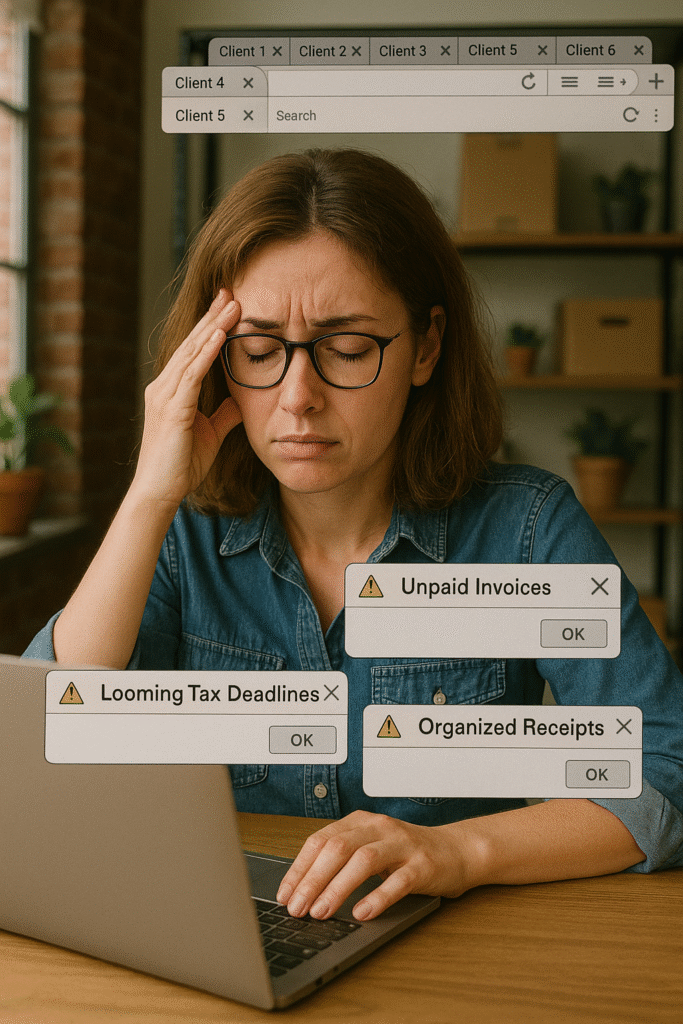
    A stressed small business owner in a denim shirt sitting at her desk with her hand on her temple, surrounded by digital browser tab overlays showing unpaid invoices, looming tax deadlines, and disorganized receipts, symbolizing mental overload and multitasking fatigue.
    Overwhelmed Entrepreneur – Mental Overload from Unpaid Invoices and Tax Deadlines – Gestora.ca

    Clearing the Mental Clutter

    Content fatigue often isn’t just about the content—it’s about bandwidth.

    Your brain is like a computer browser. If you have 50 tabs open—client work, unpaid invoices, unorganized receipts, looming tax deadlines—your processing speed for creativity is going to crawl to a halt.

    You cannot be creative when you are stressed about administration.

    If you’re sitting there staring at the blinking cursor, ask yourself: Is it really writer’s block? Or is it that your brain is secretly worrying about that shoebox of receipts you haven’t looked at since March?

    This is where the “solopreneur” mindset can sometimes hurt us. We think we have to do it all to be successful. But true success is knowing what only you can do, and getting help for the rest.

    Finding Your Relief Valve

    Imagine if you didn’t have to worry about the “backend” of your business.

    If you knew your bookkeeping was being handled, your receipts were organized, and you had a clear picture of your monthly profit without having to open a spreadsheet, how much mental energy would that free up?

    Probably enough to finally write that blog post.

    At Gestora, we see this every day. We don’t just see receipts; we see the stress they cause. Our goal isn’t just to balance your books; it’s to balance your business life. We handle the admin grunt work—and even offer smart, AI-powered tools to help with marketing tasks—so you can get back to your zone of genius.

    Sometimes, the best cure for writer’s block isn’t a writing course. It’s taking a completely different heavy task off your plate so you have room to breathe again.

  • The Freelancer’s Midnight Panic: How I Stopped Drowning in Admin Chaos

    The Freelancer’s Midnight Panic: How I Stopped Drowning in Admin Chaos

    The Freelancer’s Midnight Panic: How I Finally Escaped the 11:47 p.m. Spiral

    It was 11:47 p.m. on a Tuesday — that strange hour when your coffee is still warm, your to-do list is somehow longer than when you started, and your brain feels like a browser with 37 tabs open. I was sitting in my apartment in Montréal, squinting at Canva templates, trying to make an Instagram post for a client who wanted something “modern but retro, edgy but safe.” The kind of brief that makes you question both the laws of design and the existence of sleep.

    Somewhere between my fifth coffee and my third font change, I realized this wasn’t just a “me” problem. This was every freelancer I knew. We’re the ultimate Swiss Army knives — one day we’re accountants, the next we’re social media strategists, customer service reps, marketing directors, and occasionally, our own unpaid therapists. We wear every hat in the shop and then wonder why our necks hurt.

    The Life of a One-Person Department

    If you’ve ever juggled three clients, two invoices, and one existential crisis before breakfast, you know the drill. You promise yourself you’ll get organized. You buy a fancy planner, download the latest project management app, maybe even colour-code your Google Calendar. For a week, it feels like you’ve cracked the code. Then one late night, you find yourself deep in a rabbit hole of “free invoice templates,” wondering why the universe made bookkeeping sound so easy on YouTube.

    That was me. Living proof that you can be good at your craft and still lose half your billable hours chasing receipts, updating spreadsheets, or trying to remember if you sent that last invoice to the right “Jennifer.” (There are always at least three.)

    When the Hustle Becomes the Hamster Wheel

    At some point, freelancing stopped feeling like freedom and started feeling like a treadmill set just a bit too fast. I wasn’t building my dream — I was maintaining my exhaustion. The gig economy glorifies the grind, but no one talks about the 11:47 p.m. panic — that sinking feeling when you realize you’re your own boss, employee, accountant, and IT department.

    That’s when I decided to stop doing everything the hard way. I didn’t need to hustle harder; I needed to work smarter. Automating the boring stuff became my new obsession. I started small — setting up automatic invoice reminders, syncing my receipts to the cloud, and scheduling my posts in advance instead of in caffeine-fueled bursts of chaos.

    When Automation Feels Like Self-Care

    Here’s the funny part: the moment I stopped micromanaging every corner of my business, I actually started enjoying my work again. Automation didn’t steal my creativity — it protected it. Suddenly, I wasn’t waking up in cold sweats over unpaid invoices or scrambling to file expenses at tax time.

    Then came the real game-changer.

    One night, in my usual scroll-of-desperation, I stumbled upon Gestora.ca — a platform clearly built by people who know what 11:47 p.m. feels like. The kind of people who’ve stared at a pile of receipts and muttered, “There has to be a better way.” Turns out, there is.

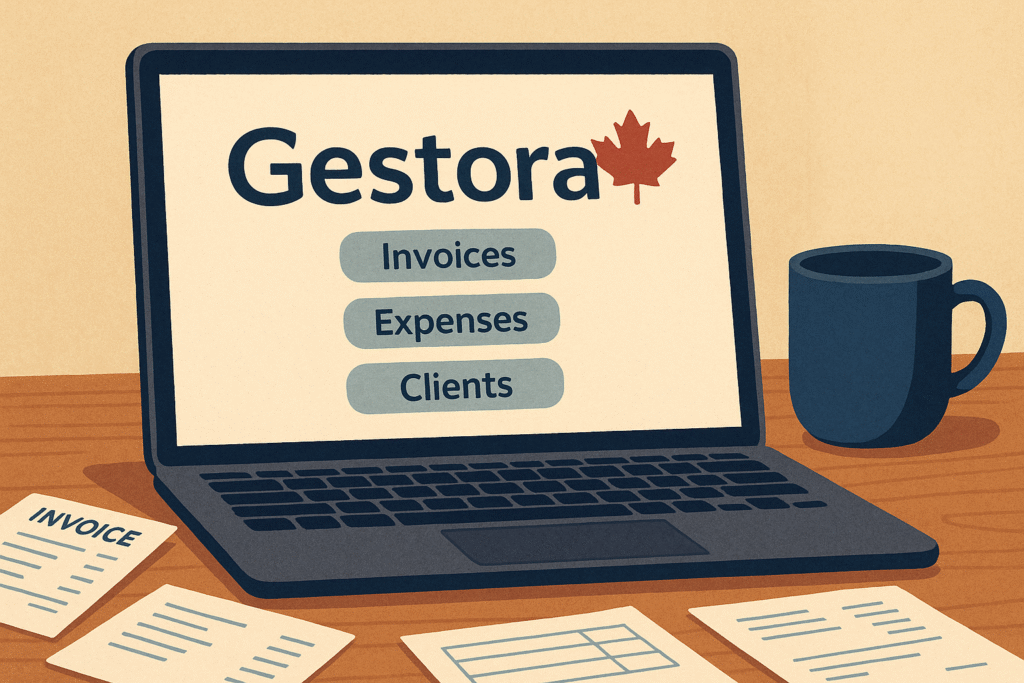
    Illustration of a laptop screen displaying the Gestora platform with options for invoices, expenses, and clients beside a blue coffee mug and scattered receipts on a wooden desk, symbolizing practical financial management for Canadian freelancers and small business owners.

    A Platform That Gets It

    Gestora wasn’t another shiny app shouting buzzwords about “optimization” or “synergy.” It was practical. Human. Canadian. The platform understood the messy middle of small business life — where you don’t have a finance department, just a growing list of clients and the constant hum of “Did I log that expense?” in the back of your head.

    For micro and small business owners, freelancers, gig workers, and self-employed pros, Gestora feels like having a quiet assistant who handles the admin chaos while you focus on what you actually love — your craft, your clients, your growth. It takes care of the unglamorous parts: coding receipts, organizing transactions, tracking income, and helping you see a clear profit and loss without needing a finance degree.

    It’s like finally hiring someone to sweep up your mental workspace — except they don’t need coffee breaks, and they never call in sick.

    The Moment the Panic Fades

    A few weeks in, I realized something wild: I hadn’t stayed up past midnight in days. My browser tabs were down to a reasonable dozen. My mornings were quiet again — not because I’d “made it,” but because I’d stopped trying to do it all myself.

    There’s a peace that comes with knowing your numbers are in order, your invoices are automatic, and your marketing isn’t living in a scattered spreadsheet. It’s like turning on cruise control after years of white-knuckling the steering wheel.

    I still work hard, but now it feels like I’m steering the ship instead of paddling with a spoon. And that 11:47 p.m. panic? Replaced with a deep, glorious sleep — the kind that only happens when your business finally runs smoother than your espresso machine.

    Final Thought

    If you’re a freelancer or small business owner burning both ends of the candle — stop and take a breath. You don’t need to be the whole company. You just need the right system behind you. Let the tech handle the grunt work so you can get back to doing what got you into business in the first place.

    Because freedom isn’t about working for yourself; it’s about finally feeling free while you do it.

    And if it’s already 11:47 p.m. while you’re reading this — close those tabs, my friend. Gestora’s got this one.

  • That Fresh $20 Notebook vs. Your $200,000 Business: The Real Cost of “Doing it Yourself”

    That Fresh $20 Notebook vs. Your $200,000 Business: The Real Cost of “Doing it Yourself”

    It’s a ritual, isn’t it? That fresh-start feeling. But what’s the real cost of DIY bookkeeping? For many freelancers, it starts with a beautiful, crisp, $20 notebook. Maybe it’s a Moleskine. Or perhaps you’ve just downloaded a complex, multi-tabbed spreadsheet template for your P&L. “This is the year,” you think, “the year I finally get my expenses organized.”

    As freelancers and self-employed professionals, we all start with the best intentions. That notebook is our symbol of discipline. The spreadsheet is our fortress of financial clarity. For the first few weeks of the fiscal year, it actually works. You diligently log your software subscriptions, your client coffee receipts, and your mileage. It feels good. You feel like a “real” small business owner.

    A side profile photo of a focused woman with short, curly brown hair and glasses, looking intently at a computer screen that displays what appears to be complex data or a spreadsheet. She rests her chin on her hand, surrounded by a cluttered desk with a calculator, notebook, phone, headphones, and a drink, embodying the stress of managing small business finances.
    It’s easy to get lost in the numbers when you’re a busy professional. This is the “administrative friction” we aim to eliminate.

    But then, life happens.

    A big project lands on your desk. You’re a graphic designer pulling all-nighters to meet a deadline, not an accountant. You’re a gig worker chasing back-to-back rides during a storm, not a data-entry clerk. That nagging pile of receipts gets shoved into a shoebox, or your email inbox fills up with digital ones you promise you’ll “get to later.” That end-of-the-month reconciliation, eh? It gets pushed to the next month. And the next.

    Suddenly, it’s tax season. And that optimistic $20 notebook is now a source of pure dread.

    I still get a cold-sweat remembering the year I missed a $4,000 deduction. I’d done the work. I’d tracked the expense. But in my haste, I’d accidentally saved the latest version of my expense sheet on my desktop, not the cloud, and I filed my taxes using an old version. Four thousand dollars. Gone. Not because I was bad at my job, but because I was human.

    The Villain Isn’t You—It’s “Administrative Friction”

    Here’s the hard truth we need to admit: the challenge isn’t the software. The problem isn’t the notebook. The problem is the discipline of manual entry when you’re already swamped.

    We are brilliant at the work we get paid for. We’re experts at design, coding, writing, building, or providing a service. But we are, almost universally, terrible at the administrative friction that comes with it. This is the “shadow work” that drains our energy—the relentless, low-value task of just managing the business instead of building it.

    The True Cost of DIY Bookkeeping (It’s Not $20)

    That $20 notebook, or that complex spreadsheet, isn’t just a tool; it’s a second job that doesn’t pay. It demands extra hours from our week, hours we should be spending on billable work or, frankly, with our families. It’s a system that relies on our perfect, unwavering discipline, and when we (inevitably) fail to provide it, we’re the ones who pay the price in missed deductions and financial stress.

    Micro and small business owners don’t fail because they lack passion. They get crushed by the weight of paper.

    So, what’s the alternative? We need a system that feels like it’s doing the bookkeeping for us. A system that works in the background, not one that demands our attention every night.

    Imagine snapping a photo of a receipt, and it just… disappears, reappearing later on a perfectly categorized P&L statement. Imagine your bank transactions being automatically sorted, coded, and reconciled while you sleep. Imagine knowing your true profitability, in real-time, every single day, not just once a year when your accountant delivers the bad news.

    This isn’t a fantasy. This is what automated bookkeeping is all about. It’s about eliminating that “administrative friction” for good. It’s about building a system that serves us, so we can get back to doing the work we actually love.

    Ultimately, that $20 notebook is a great place to jot down your brilliant ideas. But as a tool for running a $200,000 business? It’s costing you a lot more than $20. It’s time to upgrade our systems to match our ambitions.

  • Small Business Bookkeeping Savings: How to Stop Paying Your Accountant $5,000 Just for Bookkeeping

    Small Business Bookkeeping Savings: How to Stop Paying Your Accountant $5,000 Just for Bookkeeping

    Hey there, my fellow self-employed warrior.

    I see you. It’s late January and you’ve got coffee stains on your favourite shirt. Then, you’re staring at that enormous pile of invoices and expense receipt, in which, the inevitable paper blizzard is running your own show. It’s not the taxes themselves that give you that knot in your stomach. It’s the monthly and yearly rituals: the painful, drawn-out processes of preparing everything for your accountant, knowing exactly how this movie ends.

    It ends with a hefty invoice.

    For years, I played this game and I lost every time. I’d drive to snow and sleets to deliver my documents, sometimes literally a shoebox, sometimes a tangled web of spreadsheets and then I’d wait…and wait…and wait. A few weeks later, the email would arrived. The hefty invoice presented itself. It was always a shocker…easily hitting thousands of dollars.

    The Hidden Tax on Success: How to Unlock Small Business Bookkeeping Savings

    I finally had to look that invoice in the eye and ask myself, “What exactly am I paying for here?”

    The answer was crushing as if I was paying a high-level, highly skilled professional to do data entry.

    Think about it. Accountants are brilliant. They’re tax strategists, financial planners, and legal navigators. Their expertise is worth every penny when they are saving you money on taxes or helping you structure a major business decision.

    But when they charge you $200 to $500 an hour just to take your messy bank statement and categorize “Office Supplies” versus “Client Entertainment”? That’s not strategic work. That is an administrative cleanup and for a small business owner or freelancer trying to manage cash flow. This is a ridiculous avoidable tax on your hard-won profits. Furthermore, it’s money that should be going back into your business or honestly toward a very deserved vacation. Finding real small business bookkeeping savings makes this possible.

    The Real Problem: The Bookkeeping Gap

    The heart of this expensive mess is a simple failure to keep up with bookkeeping. Evidently, we postpone it because we’re busy actually making money. Yet, we kept telling ourselves we’ll do it later, but “later” always requires us to become a professional, detail-oriented bookkeeper for an entire weekend.

    The result? We pay our accountant a premium to bridge the “bookkeeping gap.”

    The goal is not to fire your accountant. They are crucial! The goal is to empower yourself and your business so that when you hand them your files, they can spend their time on strategy, not data transcription.

    Imagine walking into their office and saying: “Here is my P&L, my balance sheet, and all my transactions, perfectly categorized and reconciled. Just tell me how to save the most money on my next quarterly taxes.” That’s the difference between a $5,000 cleanup bill and a $500 strategic consultation.

    How to Automate Your Way Out of the Shoebox

    The good news for today’s self-employed professionals and gig workers is that you no longer need an advanced accounting degree to do great bookkeeping. You just need smart tools.

    The shift I made years ago was finding a platform that automatically pulled my transactions and sorted them, practically eliminating manual entry. It was like hiring a virtual administrative assistant for pennies on the dollar.

    This is where a tool like Gestora really changes the game for micro business owners.

    It handles the tedious, time-consuming tasks you hate:

    • Automated Bookkeeping: It connects to your bank and credit cards using a standard protocol for secure communication over a computer network and uses AI to categorize every transaction. No more shoeboxes.
    • Instant Financial Reports: You click a button and have an up-to-date P&L (Profit & Loss) statement and key reports available, anytime. This is the exact output your accountant needs, polished and ready to go.

    By outsourcing the grunt work to intelligent automation, you ensure your records are always clean, always current, and always ready for your accountant. You transform the conversation from “What are these receipts?” to “What’s the best strategy?”

    This efficiency not only saves you thousands on accounting fees, but it also gives you real-time financial clarity, the business intelligence you need to actually grow. When you know your margins instantly, you can raise your prices or cut unnecessary costs.

    Stop paying your experts to do entry-level work. Invest in a system that makes you, the business owner, the master of your own financial house. Your accountant will thank you, and your bank account will, too.

    To take back control and slash those nasty year-end fees, check out how simple professional bookkeeping can be for your small business. ➡️ Learn more about effortless automated bookkeeping at Gestora