
Category: Blog

Your blog category

  • The Vault is Finally Open: What Mark Carney’s “Consumer-Driven” Revolution Means for Your Business

    The Vault is Finally Open: What Mark Carney’s “Consumer-Driven” Revolution Means for Your Business

    Read Time: 7 Minutes | Topic: Financial Strategy / News

    For decades, the Canadian banking system has resembled a fortress. It was stable, secure, and envy-inducing during global crises. But for the small business owner trying to scale, it was also a fortress in the other sense: walled off, impenetrable, and designed to keep you inside and competitors out.

    The announcement by Prime Minister Mark Carney in 2025 has officially lowered the drawbridge.

    With the full implementation of the Consumer-Driven Banking Act, Canada is finally joining the rest of the modern world. This isn’t just a policy tweak; it is a fundamental rewriting of who owns your financial life.

    If you are a solopreneur, a freelancer, or a small shop owner, the “Carney Doctrine” of productivity and dynamism just handed you the most powerful asset you possess: Your own data.

    Here is what the Canadian banking system used to be, what it is today, and why Gestora is the only co-pilot you need to navigate this new frontier.

    The “Before”: The Oligopoly and the Screen Scraper

    To understand the magnitude of this shift, we have to look at the status quo we are leaving behind.

    For the last century, Canadian finance has been dominated by the “Big Five” (or Six, depending on who you ask). This oligopoly provided stability, but it stifled competition.

    • Data Silos: If you banked with Bank A, your transaction history—the proof of your business’s health—lived and died on their servers. If you wanted a loan from Bank B, you had to print out PDFs, highlight rows, and beg them to believe you.
    • The “Screen Scraping” Nightmare: To use modern fintech tools (like budgeting apps), you often had to hand over your username and password. These apps would use “screen scraping” technology to log in as you and copy-paste your data. It was risky, slow, and often violated your bank’s terms of service, leaving you liable if things went wrong.
    • The Innovation Gap: Because the banks faced little threat from outsiders, they had little incentive to build tools that truly served the “little guy.” You got the products they wanted to sell, not the solutions you needed to grow.

    The “Now”: The Carney Doctrine

    Prime Minister Carney’s announcement pivots the nation toward what he calls “governed dynamism”. Drawing on his long-standing critique of Canada’s “productivity problem”, the new framework is built on a simple premise: Competition breeds competence.

    The newly enacted framework relies on secure APIs (Application Programming Interfaces).

    1. Data Sovereignty: You no longer “ask” your bank to share your data. You direct them to. If you want to share your cash flow history with a new lender, an accounting platform, or Gestora, the bank must provide that data instantly, securely, and in a standardized format.
    2. Liability Clarity: The “screen scraping” gray zone is dead. The new Act clearly defines who is responsible if data is breached, meaning you are no longer betting your life savings on a Terms & Conditions checkbox.
    3. The “Write” Phase: While we are starting with “Read” access (viewing data), the roadmap explicitly includes “Write” access—meaning soon, you will be able to initiate payments and move money across platforms without ever logging into a traditional bank portal.

    What This Means for the “Grasshoppers and Ants”

    In his speeches, Carney has often referenced Aesop’s fable of the Ant and the Grasshopper, warning that Canadian businesses risk “wasting their days in the sun” if they don’t become more productive.

    For the small business owner, Open Banking turns you into the ultimate “Ant.” It allows you to store, move, and utilize your resources with an efficiency that was previously reserved for the Fortune 500.

    • Instant Adjudication: Lenders can now plug directly into your revenue stream. They don’t need to guess your risk based on a static credit score; they can see your real-time cash flow, allowing for faster, fairer loans.
    • The End of “Loyalty Tax”: You are no longer trapped. If your bank raises fees, you can move your entire financial history to a credit union or digital bank in minutes, not months. The friction of switching is gone.
    • Hyper-Personalization: The “Digital Imperative” we discussed last week is now turbocharged. Your financial tools can see the full picture—your credit cards, your chequing, your loans—in one dashboard, regardless of which institution holds them.

    Where Gestora Fits: The Hub of the New Economy

    This is where the rubber meets the road.

    The giants—the Big Banks—are scrambling. They are building their own “walled gardens,” trying to convince you that “Open Banking” just means seeing your credit card on your chequing app. They want to keep you inside their ecosystem.

    Gestora is different. We are the Switzerland of your finances.

    In an Open Banking world, Gestora acts as the central operating system (OS) that aggregates everything.

    1. The Universal Translator:
    2. We connect to the new secure APIs of every institution. Whether you bank with RBC, Vancity, or a digital-only startup, Gestora pulls that data into a single, unified “Glass Box.” We don’t care where your money lives; we just care that you understand it.
    3. From Data to Strategy:
    4. The Giants will give you a pie chart of your spending. Gestora gives you a roadmap. Because we have access to your real-time data flow (thanks to the new Act), our AI Co-Pilot can forecast cash crunches weeks before they happen. We don’t just show you the transaction; we tell you what it means for your tax bill next April.
    5. Audit-Ready, Always:
    6. With the new secure data pipes, Gestora’s “Audit-Ready” promise is stronger than ever. There are no broken bank feeds or missing transactions. The data comes straight from the source, verified and immutable. You are compliant by default.

    The Advantage of the Agile

    The Big Banks are trying to retrofit legacy systems from the 1980s to work in this new open world. They are turning a battleship.

    Gestora was built for this. We were born in the cloud, designed for APIs, and engineered for the speed of the solopreneur.

    While the giants try to figure out how to stop you from leaving, we are focused on helping you arrive. We use Open Banking not to trap you, but to liberate you—giving you the clarity to negotiate better rates, the peace of mind that your data is secure, and the freedom to run your business, not your bank account.

    The vault is open. Come see what’s inside.

  • The Digital Imperative: Why 2026 is the Year You Automate or Stagnate

    The Digital Imperative: Why 2026 is the Year You Automate or Stagnate

    For years, “going digital” was a nice-to-have. It was a bonus line on a grant application or a way to show off to tech-savvy clients. But as we settle into 2026, the landscape has shifted fundamentally.

    The latest Bank of America Business Owner Report puts it bluntly: we have entered the era of the “Digital Imperative.”

    The numbers are staggering. An overwhelming 91% of business owners plan to utilize digital tools, including AI, in the next five years. Even more telling? 77% have already started, integrating AI into everything from marketing copy to customer service queries.

    This isn’t just about chasing the shiny new toy. It is a direct response to a labor market that remains tight—61% of businesses cite labor shortages as a major challenge. When you can’t hire more hands, you have to build better tools.

    For the Canadian solopreneur, this data serves as both a validation and a warning. The validation? You were right to move your business online. The warning? If you aren’t automating your routine tasks, you are about to be outpaced by a competitor who is.

    The “Boring” Magic of Automation

    When we talk about the “Digital Imperative,” it’s easy to imagine futuristic robots or complex algorithms. But the real revolution is happening in the mundane.

    The report highlights that emerging technologies are enabling owners to automate routine tasks like scheduling, invoicing, and inventory tracking.

    Think about your average Tuesday. How much of it is spent sending “Just following up on this invoice” emails? How much time do you lose cross-referencing your calendar with your booking tool?

    In 2026, doing these tasks manually is the business equivalent of washing your clothes in a river when you have a washing machine in the basement. It’s hard work, sure, but it’s not smart work.

    By offloading these repetitive, low-value tasks to digital tools, you free up your most valuable asset: Brainpower. You get to focus on the strategic, creative, and relationship-building work that actually drives revenue.

    The Security Question You Can’t Ignore

    There is another side to this digital coin that the report rightly flags: Cybersecurity.

    As we move more of our lives online, the risks multiply. Nearly one-third (30%) of businesses are now prioritizing enhanced cybersecurity measures.

    For a small business, “cybersecurity” often feels like an enterprise problem. But hackers don’t just target the big banks; they target the low-hanging fruit. A solopreneur with weak passwords and unencrypted client data is a prime target.

    The “Digital Imperative” means that protecting your data—and your client’s trust—is now a baseline requirement for doing business. You cannot build a reputation for reliability if your digital house has no locks.

    How Gestora Became the “Digital Imperative” in a Box

    When we analyzed these trends at Gestora, we realized that small business owners were being asked to do the impossible. You are expected to be an AI expert, an automation engineer, and a cybersecurity analyst—all while running your actual business.

    We didn’t think that was fair. So, we built Gestora OS to be the answer to the Digital Imperative.

    We designed our platform to act as the central nervous system for your business operations. We looked at those “routine tasks” the report mentions—invoicing, tracking, scheduling—and we automated them.

    • The Efficiency Engine: Instead of buying five different tools for invoicing, expense tracking, and tax prep, Gestora consolidates them. Our AI works in the background, categorizing your expenses and preparing your invoices so you don’t have to. We turn that “labor shortage” into a non-issue by giving you a digital employee that never sleeps.
    • Built-in Security: We took the 30% concern about cybersecurity to heart. Gestora is built with bank-level encryption and robust authentication protocols. You don’t need to hire an IT consultant to secure your financial data; you just need to log in. We provide the “stronger authentication and data protection” the market demands, right out of the box.
    • Strategic Freedom: By trusting Gestora to handle the digital heavy lifting, you join the 91% of forward-thinking owners who are ready for the future. You stop being a data entry clerk in your own company and start being the CEO.

    The Digital Imperative isn’t about replacing the human element of your business. It’s about protecting it. It’s about building a digital fortress around your operations so you can thrive in 2026 and beyond.

  • The Centaur Strategy: Why the Future of Business is Half-Human, Half-Machine

    The Centaur Strategy: Why the Future of Business is Half-Human, Half-Machine

    In the world of ancient mythology, there is no creature quite as striking as the Centaur. With the upper body of a human and the lower body of a horse, it combined human intelligence and spirit with the raw power and speed of a beast. Neither half could achieve on its own what they could accomplish together.

    As we look at the landscape of 2026, I want to propose a new kind of mythology for the Canadian solopreneur: The Centaur Strategy.

    Lately, the conversation around Artificial Intelligence has been polarized. On one side, there is the fear that machines are coming for our jobs. On the other, there is the hollow promise that technology can do everything for us while we sit on a beach. Neither is true.

    The most recent Deloitte study on Canada’s AI future, Building Canada’s Brightest AI Future, introduces a much more grounded and exciting concept: Human-AI Synergy.

    The report argues that the biggest performance improvements don’t come from replacing humans, but from strategic collaboration. It’s about a partnership where AI handles the heavy lifting—the “beast” of data and repetition—so the human “mind” can focus on creativity, empathy, and complex strategy.

    Making Good Workers “Great”

    I love how the report puts it: AI is something that extends our abilities. If you are already a good programmer, writer, or consultant, AI won’t replace you; it will make you great. It amplifies your cognitive strengths and automates the mundane.

    Think about your daily life as a freelancer or small business owner. You are a “one-person show.” You are the CEO making the big decisions, the CMO finding the clients, and the CFO managing the books.

    You don’t need a replacement. You need a clone. You need that “horse half” to handle the miles of administrative terrain so your human half can stay fresh for the finish line.

    A Glimpse into the “Bright Future”

    The Deloitte report illustrates this beautifully through the story of a man named Dev. In a “Bright Future” scenario set in 2030, Dev meets with an AI financial advisor named FIN.

    Dev isn’t just handing over his life savings to a robot and walking away. Instead, he uses FIN to process vast amounts of market trends and policy changes. FIN explains the rationale behind its suggestions in simple terms.

    But here is the most important part of the story: when FIN suggests a new, complex investment opportunity in cryptocurrency, Dev doesn’t just click “buy.” He leans back and contemplates. He decides he needs more time to think it over and asks to schedule a follow-up with a human advisor.

    FIN doesn’t get offended or pushy. It simply arranges the meeting.

    This is synergy. The AI did the data crunching, and the human provided the wisdom and final judgment. Dev ended the call feeling reassured. He had clarity because he was still the one in the driver’s seat.

    The “Centaur” in Your Own Workspace

    For a solopreneur, the Centaur Strategy is about finding your own “FIN.”

    We often spend 60% of our time on what I call “survival tasks”—categorizing receipts, double-checking tax remittances, and organizing marketing data. These are the tasks that drain your battery and rob you of your peace of mind.

    When you operate as a Centaur, you delegate those high-volume, repetitive tasks to a system designed to handle them with machine-like precision.

    Imagine waking up and knowing that your financial data has already been sorted, your tax obligations have been predicted, and your cash flow forecast is ready for review. You aren’t doing the work; you are reviewing the work. You are the strategist. You are the human mind at the top, directing the power underneath.

    This synergy allows you to “punch above your weight class.” It gives a single person the operational horsepower of a ten-person agency.

    How Gestora Becomes Your “FIN”

    This vision of a collaborative, human-centric future is exactly why we built Gestora OS.

    We didn’t want to build a tool that makes decisions for you. We wanted to build the “horse half” of your Centaur business—a powerful, reliable AI Co-Pilot that handles the “beast” of data processing so you don’t have to.

    We focused on creating a platform that offers valuable insights without the noise.

    • The Data “Beast”: Gestora OS excels at processing vast amounts of financial and marketing data. It handles the categorization and organization that usually takes you hours.
    • The Human Mind: We provide you with the clarity you need to make the final call. Our dashboard is designed to be your “FIN,” presenting data in a way that is easy to understand, so you can focus on client relationships and creative strategy.
    • True Peace of Mind: By automating the mundane, we give you your time back. You can move through your day with the confidence that the foundational work is being handled accurately, leaving you free to grow your business.

    Winning the Marathon

    The Deloitte report reminds us that the transition to an AI-powered world is a “marathon, not a sprint”. It requires us to nurture our “timeless human capabilities”—curiosity, creativity, and empathy.

    You were never meant to spend your life as a data entry clerk. You were meant to be a creator, a problem solver, and a leader.

    By embracing the Centaur Strategy, you aren’t giving up your role in your business. You are finally stepping fully into it. You are providing the vision, while your technology provides the path.

  • The “Mystery Box” Problem: Why You Need Clarity Before You Trust AI With Your Money

    The “Mystery Box” Problem: Why You Need Clarity Before You Trust AI With Your Money

    If the idea of handing your hard-earned business revenue over to an AI makes you nervous, you are not alone. In fact, you are in the majority.

    A new report on Canada’s future reveals a startling number: Only 31% of Canadians say they trust AI. That is significantly lower than the global average.

    Why the hesitation? It isn’t because we are afraid of technology. It’s because, as business owners, we know the stakes are high. When a chatbot makes up a funny story, it’s a meme. When a financial tool makes up a tax deduction, it’s a problem.

    We all want the speed of AI, but we need peace of mind. We need to know that the numbers are right.

    This brings us to a crucial concept from the new Deloitte report, Building Canada’s Brightest AI Future. It explains why some AI tools feel like risky gambles, while others offer the clarity and value your business deserves.

    It comes down to the difference between a “Black Box” and a “Glass Box.”

    The Tale of Two Advisors: A Story from 2030

    To explain why this matters, the report tells the story of a father named Dev who is trying to save for his daughter’s education.

    First, Dev tries an AI advisor called “B-FIN.” He asks it for help, and the AI immediately suggests a high-risk, aggressive strategy. When Dev asks why it chose that path, the AI gives him confusing jargon and opaque reasoning. It pushes him to just say “yes” without explaining the logic.

    Dev feels uneasy. He can’t see the math. He shuts down the account.

    Then, Dev tries a different system called “FIN.”

    This experience is completely different. FIN shows him clear, easy-to-understand charts. It explains exactly why it is making a recommendation—pointing to specific changes in government policy that benefit his portfolio. It treats him like a partner, not just a user.

    Dev leaves that meeting feeling reassured. He found clarity.

    The “Black Box” Trap

    In the tech world, Dev’s first bad experience is what we call a “Black Box” model. You put data in, and an answer pops out, but you have no idea how it got there.

    For a creative writer, a Black Box is fine. For a Canadian solopreneur managing taxes and cash flow, it is a liability.

    If your software tells you to categorize an expense a certain way, but can’t tell you why, you don’t have control. You are just guessing. And in business, guessing is expensive.

    The “Glass Box” Standard

    The alternative—and the standard you should demand—is the “Glass Box”.

    A Glass Box system is transparent. You can see inside it. You can trace the decision from A to B. It builds trust because it doesn’t ask for blind faith; it offers proof.

    The report highlights that this kind of transparency is the key to responsible business. It allows you to catch errors, understand your own data, and sleep better at night knowing you aren’t exposed to hidden risks.

    How Gestora Brings Clarity to Your Chaos

    When we built Gestora OS, we read the room. We knew that Canadian entrepreneurs didn’t want a “magic trick”—they wanted a reliable tool that offered great value and robust protection.

    We made a choice to avoid the “Black Box.”

    A small business owner holding Gestora on the hand.

    We designed Gestora OS to be a Glass Box for your business. We believe you deserve to know exactly what is happening with your data.

    • Traceable Logic: When our system helps you organize your finances, it isn’t guessing. It follows clear, Canadian tax rules. You get the clarity of knowing why a receipt belongs in a specific category.
    • Audit-Ready Confidence: Because our system is transparent, your data is always ready for review. This gives you the ultimate peace of mind—if the CRA ever asks questions, you have the answers ready.
    • Human Control: The report says the best results come from “Human-AI Synergy”. We agree. Gestora doesn’t replace you; it does the heavy lifting so you can make the final call.

    The Bottom Line

    Trust is earned through transparency.

    As you look for tools to help you grow in 2026, don’t settle for mystery. Your business is too valuable to leave to chance. Look for the tools that show their work. Look for the tools that give you clarity.

    Look for the Glass Box.

  • The Ambition Gap: Why Canada’s Solopreneurs (Not Corporations) Will Fix the Productivity Crisis

    The Ambition Gap: Why Canada’s Solopreneurs (Not Corporations) Will Fix the Productivity Crisis

    If you have been feeling like the Canadian economy is stuck in second gear, you aren’t imagining things. We are living through what economists politely call a “productivity crisis,” accompanied by a stagnation in our average standard of living.

    For those of us on the ground—freelancers, agency owners, and independent consultants—this isn’t just a macroeconomic headline. It’s the reality of working harder for dollars that don’t stretch as far as they used to.

    I recently spent some time with a comprehensive new report titled Building Canada’s Brightest AI Future by Deloitte. It is a dense, rigorous look at where our country stands on the global technology stage. While the report is written for policymakers and enterprise CEOs, there is a subtext screaming out from the pages that I believe is actually addressed to you—the Canadian solopreneur.

    The report identifies a critical flaw in our national business machinery. It’s not a lack of talent; we have world-renowned researchers and an impressive talent pool. It’s not a lack of government funding; billions have been earmarked for infrastructure.

    The problem is what the report calls an “ambition problem”.

    Specifically, Canada is suffering from a risk-averse culture. While the rest of the world is racing to adopt new tools to become more efficient, Canadian businesses are stuck in a “wait-and-see” approach.

    But here is my thesis for 2026: Big business might be waiting, but you don’t have to.

    The “Wait and See” Trap

    The Deloitte findings paint a frustrating picture of the corporate landscape. In the US, companies are diving into AI and automation. They pick a use case, launch it, and fix the governance along the way because they prioritize ROI above all else.

    In Canada? We hesitate.

    Canadian companies are happy to educate their boards and write policy papers, but “as soon as you go to developing and integrating a solution, everything just stops”. It takes, on average, 18 months to start building an AI product in Canada, compared to just four months in the United States.

    This hesitation is creating an “Ambition Gap.”

    We are collectively paralyzed by the fear of getting it wrong. We analyze, we plan, we committee-meeting ourselves to death. And while we are “waiting to be forced to do it,” our global competitors are pulling ahead.

    For a large corporation, this sluggishness is a strategic error. For a solopreneur, it is an opportunity.

    The Solopreneur’s Advantage: Agility as a Superpower

    As a small business owner, you possess the one asset that the big banks and telecom giants effectively lost years ago: Agility.

    You do not have a Board of Directors that needs to sign off on a new software subscription. You do not have a procurement department that takes six months to approve a new workflow. You are the CEO, the CFO, and the IT department wrapped into one.

    The Deloitte report suggests that if Canada fully adopts AI, our real GDP could be 5% to 8% higher in the next 10 years.

    Translate that to your business. What would your life look like if your personal “GDP”—your revenue and output—increased by 8% not because you worked more hours, but because you worked better?

    To achieve this, we have to reject the national mood of risk aversion. We have to stop “waiting and seeing” and start “defining ambition”.

    What “Defining Ambition” Looks Like for Us

    The report outlines a framework for success that starts with “Ambition.” It defines this as a “visionary mindset with a sharp focus on creating value”.

    For the Fortune 500, this means billion-dollar R&D budgets. For the “Fortune 1” (that’s you), it means ruthlessly eliminating the low-value work that clogs your day.

    We often confuse “busyness” with “business.” We spend hours categorizing expenses, chasing invoices, trying to predict our tax bills, and organizing client data. We feel productive because we are tired at the end of the day. But are we creating value?

    True ambition in 2026 means automating the survival tasks so you can focus on the growth tasks. It means looking at your operations and asking, “Why am I doing this manually when the technology exists to do it instantly?”

    Turning Technology into Infrastructure

    This is where the conversation usually pivots to buying a dozen different AI tools—a chatbot for this, a writer for that. But that leads to subscription fatigue, not productivity.

    The report highlights that for AI to work, it needs to be sustainable and scalable. It’s not about flashy experiments; it’s about integrating intelligence into the bedrock of your business.

    This philosophy is exactly what drove the architecture of Gestora OS.

    A man in a desert landscape observes a large, futuristic machine labeled "GESTORA OS: THE AMBITION ENGINE," which is connected via a pipeline of floating data icons (including tax and dollar signs) to a modern office building. A holographic interface in front of the man displays text: "FINANCIAL & DATA MANAGEMENT AUTOMATION: CATEGORIZATION, TAX PREDICTION, COMPLIANCE" and "OPERATIONAL EFFICIENCY". The scene is set against a sunset.

    When we looked at the landscape of financial tools available to Canadian small businesses, we saw the same “wait and see” hesitation the report describes. Most tools were just digital versions of paper ledgers—passive, reactive, and requiring heavy manual input.

    We decided to build something for the ambitious.

    We designed Gestora OS to be the “Ambition Engine” for your business. We realized that if we could automate the financial and data management layer—the categorization, the tax prediction, the compliance—we could give solopreneurs the same operational efficiency as a large enterprise.

    • We focused on Value Creation: The report urges leaders to define ambition with a relentless focus on value. Gestora OS automates the data entry so your focus remains 100% on your clients and your craft.
    • We removed the Lag: Remember that 18-month vs. 4-month statistic? By integrating advanced financial intelligence directly into your dashboard, we let you skip the R&D phase. You get the benefits of a “smart” finance department immediately, without the wait.
    • We embraced the Vision: You have a vision for your business that goes beyond paperwork. Our vision is to be the silent operating system that makes yours possible.

    The Window is Closing

    There is a sense of urgency in the Deloitte findings. We have a “small window of the next five years or so” where our choices will determine if we lead or fall behind. The risk of “missing the AI wave” is real, just as we missed the Internet wave in the early 2000s.

    The economy might be fragile, and the regulations might be complex, but the path forward isn’t to retreat into a shell of caution.

    The path forward is to act.

    As we head into this new era, let’s leave the “wait and see” attitude to the dinosaurs. Let’s decide that 2026 is the year we stop working for our administration and start making our administration work for us.

    Let’s be ambitious.


    This is part one of our “Future-Proof” series, breaking down the future of Canadian business technology. Next week, we will tackle the “Glass Box” paradox—why trusting your data is more important than ever.

  • Optimism is Back, But So Is the Red Tape: Navigating the 2026 Regulatory Landscape

    Optimism is Back, But So Is the Red Tape: Navigating the 2026 Regulatory Landscape

    As we close out 2025, there is a palpable sense of resilience in the air. I’ve been speaking with many of you in our community—from the coffee shop owners in Vancouver to the freelance graphic designers in Halifax—and the sentiment matches what the data is finally showing.

    According to the latest findings from the Canadian Federation of Independent Business (CFIB), small business optimism is rebounding as we head into the new year. Long-term confidence has climbed to 59.9, hitting a year-long high that sits just shy of the historical average.

    That is the good news. We have weathered the “rollercoaster” of 2025. But as any seasoned entrepreneur knows, optimism doesn’t pay the bills—and right now, those bills are coming from a very specific, frustrating direction.

    The “Silent” Partner in Your Business

    While we celebrate the uptick in confidence, we have to look at the “fragile” reality underneath. The CFIB’s Chief Economist, Simon Gaudreault, put it perfectly: the headline numbers “don’t tell the full story”.

    The story that isn’t being told enough? The crushing weight of compliance.

    While “insufficient demand” remains a primary barrier for over half of our businesses, the real sting in the tail for 2025 comes from cost constraints. A staggering 62% of small businesses cite tax and regulatory costs as their top cost constraint to end the year.

    Think about that for a moment. It isn’t just the cost of raw materials or rent that is keeping owners up at night; it is the cost of navigating the complex web of government rules and tax obligations. This burden actually ranks higher than wage costs (60%) and insurance (58%).

    The Disproportionate Burden

    Why does this hit us so hard? Because for a solopreneur or a small team, “regulatory compliance” isn’t a department—it’s you.

    Every hour you spend deciphering a new provincial tax rule or organizing receipts for a remittance is an hour you aren’t spending on business development. It is a “time tax” that disproportionately targets the smallest players. While large corporations have dedicated compliance teams, you have late nights and weekends.

    The CFIB report notes that staffing plans remain weak, with more businesses planning to reduce positions than hire. When you are already running lean to survive a “challenging and unpredictable” economic climate, you cannot afford to waste precious manpower on administrative red tape.

    How We Buy Back Your Time in 2026

    t Gestora, our mission has always been to empower the Canadian solopreneur. We believe that technology should be the great equalizer, giving the “little guy” the same data superpowers as the big conglomerates.

    We looked at these cost constraints—specifically that 62% pain point around tax and regulation—and we realized we needed to do more.

    This is exactly why we engineered our new $14.99/month plan.

    We didn’t build this plan just to organize files; we built it to slash the “Tax and Regulatory” burden that is eating into your margins. By automating the collection, categorization, and compliance-readiness of your marketing and financial data, we essentially act as that “compliance department” you thought you couldn’t afford.

    Here is the math:

    • Reduce Professional Fees: By handing your accountant clean, standardized, regulation-ready data, you reduce the billable hours they spend fixing your books.
    • Eliminate Penalties: Accurate, automated tracking means you never miss a regulatory deadline or miscalculate a remittance.
    • Reclaim Productivity: If our tools save you even two hours of administrative work a month, the plan has already paid for itself five times over.

    Looking Ahead

    The economy might still be “fragile heading into 2026”, but your business doesn’t have to be. We can’t control the government’s regulatory changes or the global trade uncertainty, but we can control how efficiently we handle them.

    Let’s make 2026 the year we stop working for our compliance burdens and start making our data work for us.

  • The Gig Worker’s Spreadsheet Nightmare: How Micro-Business Owners Can Finally Ditch the Sunday Bookkeeping Grind

    The Gig Worker’s Spreadsheet Nightmare: How Micro-Business Owners Can Finally Ditch the Sunday Bookkeeping Grind

    The Gig Worker’s Spreadsheet Nightmare

    Let me tell you a story I’ve been carrying around for a while now — the kind that sticks with you because it’s a little funny, a little painful, and wildly familiar if you’ve ever worked for yourself in Canada.

    A few months back, I bumped into a delivery driver at a Tim Hortons in Scarborough. You know the type — hustling from Uber Eats to DoorDash to Instacart, juggling apps like a pro, sipping cold coffee because the day doesn’t always wait for you to drink it hot.

    We started chatting about earnings because… well, that’s what self-employed people do. We compare notes like hockey fans comparing playoff stats.

    He told me, with this proud little grin, “I track everything in a spreadsheet — income, tips, mileage, gas, even my daily wear-and-tear. Been doing it since 2021.”

    Now, I’m expecting to hear he uses some simple sheet. You know…the usual “Income here, mileage there, total at the bottom.” But no. He opens his laptop and shows me a spreadsheet that looks like it was built by NASA.

    Tabs. Formulas. Nested formulas. Pivot tables. Even a colour-coded “fuel volatility chart.”

    My guy didn’t have a spreadsheet. He had a space program.

    Every Sunday, he’d sit down at his dining table — armed with receipts, screenshots, and that one notebook every gig worker has — you know, the one with coffee stains and the sad little curling sticker on the cover.

    He told me he spent two hours manually crunching numbers. Two hours. Every single week.

    “So… why not automate it?” I ask.

    He shrugged. “It’s not much. I like to know where I stand.”

    And that right there is the trap many Canadian gig workers fall into — thinking their time isn’t expensive just because they’re used to doing everything themselves.

    But here’s the truth we forget when we’re knee-deep in our hustle:

    Your time is money

    And sometimes, the money you’re saving is way less than the money you’re losing.**

    For this driver, two hours every Sunday meant 8 hours a month. That’s a whole shift. That’s grocery money. That’s car payment money. That’s time he could’ve spent with his kids, doing meal prep, catching a game, or — honestly — just breathing.

    So I asked him a simple question: “What’s two hours of your time worth?”

    He didn’t even know. Most gig workers don’t.

    We’re so used to “doing it all” that we forget what we’re actually investing.

    His time was worth more than his bookkeeping. Way more.

    When I showed him the shortcut, the man looked at me like I handed him a lottery ticket

    A smiling man looking at his phone with excitement, raising his fist in celebration after receiving good news.
    That moment when Gestora.ca crunches your numbers in minutes and it feels like you just won the bookkeeping lottery.

    He uploaded his files into Gestora.ca. Ten minutes later — and I mean this literally — he had everything his spreadsheet used to take two hours to produce.

    Totals? Done. Mileage? Calculated. Expense categories? Sorted. Receipts? Filed. Tax-ready numbers? Ready.

    Ten. Minutes.

    He didn’t just save time — he got his Sundays back.

    I swear he looked at me like he just got unexpected EI backpay.

    He said, “So… I can go home now?”

    Buddy, you could go live your life now.

    The Hidden Tax of Self-Employment (No, Not the CRA One)

    If you’re a micro-business owner, freelancer, gig worker, or part-time side hustler, you already know this: Life as a self-employed Canadian is not for the faint of heart.

    You work on days other people rest. You work while it’s snowing sideways. You work when the apps glitch, when the client pays late, when the invoices get ignored, or when your body whispers, “Maybe today we don’t?”

    And despite all that… you still somehow end up wasting hours every month doing bookkeeping the hard way.

    Manual spreadsheets. Lost receipts. Mileage tracking that relies more on memory than math. “Guessing” expenses. Playing “What the hell did I buy at Canadian Tire that day?”

    It’s the invisible tax entrepreneurs pay long before CRA ever gets involved.

    But it doesn’t have to be like that.

    The Sunday Syndrome: Why We Bookkeep at the Worst Possible Time

    Ever notice we do bookkeeping only when we’re too tired to function? Sunday evenings, usually.

    Our brains are running Windows 95 at that point. Slow. Crashing. No updates.

    And yet… that’s when many gig workers choose to tackle their finances.

    Why? Because we spend the week trying to survive the hustle. And then the weekend comes, and life gets loud. Then suddenly it’s Sunday, and we’re racing the clock to stay on top of receipts before we forget them.

    Bookkeeping isn’t hard — it’s just done at the wrong time with the wrong tools.

    The Spreadsheet Illusion: “If It’s Manual, It Must Be More Accurate.”

    This is one of the biggest lies we tell ourselves.

    We think manually entering numbers = more control. More accuracy. More responsibility.

    But manual work is where mistakes actually thrive.

    One skipped kilometre log. One missing gas receipt. One wrong formula. One month where you forget to update something.

    Suddenly your entire year is off.

    Automation doesn’t weaken your control — it protects it.

    The Fear of Letting Go

    Here’s the part people won’t admit:

    Many self-employed Canadians cling to spreadsheets because they’re scared of letting go.

    Not scared of automation… Scared of what automation will reveal.

    Scared to see how much they actually spend on gas. Or parking. Or takeout during long shifts. Or supplies. Or business subscriptions. Or work-related Amazon purchases at 1 a.m.

    Automation doesn’t just organize your numbers. It holds up a mirror.

    But that mirror is what helps you grow.

    Why Tools Like Gestora.ca Matter (Especially in Canada)

    Because Canadian self-employment is a different beast.

    We deal with mileage over snowbanks. We deliver in ice storms. We file GST/HST (or QST, hello Quebec). We handle multi-channel income — apps, cash, direct transfers, e-transfers. We juggle part-time gigs with side hustles. We pivot every month because the cost of living doesn’t take a break.

    And most of us do all this… alone.

    So when a tool steps in and says, “Hey, let me handle the boring parts so you can breathe,” that’s not a luxury — that’s survival.

    Gestora.ca isn’t fancy. It’s not trying to be the next Silicon Valley unicorn. It’s practical. It’s built for normal people who don’t want to spend their evenings googling “how to calculate quarterly GST remittance.”

    It’s built for folks like the delivery driver, and like you, and like millions of Canadians who don’t need more hustle — they need more time.

    He Got His Sundays Back — And So Can You

    When that delivery driver realized he was getting two hours of his life back every week, he said something that stuck with me.

    “Feels like someone just handed me more weekend.”

    More weekend. More rest. More time to live instead of calculate.

    And that — more than any tax tip or expense trick — is the real win.

    Bookkeeping shouldn’t feel like a punishment for being self-employed.

    It should feel like clarity. It should feel like empowerment. It should feel… easy.

    If your spreadsheet looks like it belongs at NASA, or you spend Sundays doing math instead of doing life, you deserve better. You deserve tools made for the pace and chaos of modern self-employment.

    And maybe, just maybe… you deserve your Sundays back too.

  • When My Accountant Ghosted Me: How I Took Control of My Small Business Finances (and My Sanity)

    When My Accountant Ghosted Me: How I Took Control of My Small Business Finances (and My Sanity)

    When My Accountant Ghosted Me

    It was a chilly March morning, the kind where the sun pretends to shine but the air still bites. I had a cup of coffee in one hand and a pit in my stomach. Tax season had arrived — and my accountant had vanished. No replies to my emails, no returned calls, not even a “Hey, I’m swamped.” Just… radio silence.

    If you’ve ever run a small business or freelanced in Canada, you know that feeling — the quiet panic when someone you rely on just disappears. Your receipts are piled higher than Mount Tremblant, CRA deadlines are circling like hawks, and you’re still waiting for someone else to make sense of it all.

    At first, I did what any rational adult would do: I panicked, cursed my luck, and frantically Googled “how to survive tax season without losing your mind.”

    Spoiler: I didn’t. But I did find something better.

    The Wake-Up Call I Didn’t Know I Needed

    See, when you run your own business — whether you’re designing websites, driving Uber, selling coffee, or running a small marketing agency out of your spare room — people always say, “Leave the numbers to the experts.”

    And for a while, that’s comforting advice. You get to focus on your craft, your clients, your next gig. But here’s the kicker: when your “expert” disappears, you realize just how blind you’ve been.

    It’s like driving through a snowstorm with your headlights off. You can still move forward, sure, but you don’t really know where you’re going — or what you might hit along the way.

    That week, as I sat surrounded by crumpled receipts and half-filled spreadsheets, I made a decision: I would never let myself be in that position again.

    Not just because I needed my taxes filed — but because I wanted to understand my business.

    From Chaos to Clarity (With a Little Help)

    I started small. I organized my receipts — yes, the same ones that had been living rent-free in my backpack for months. I opened my business bank account and tried to make sense of my expenses.

    That’s when I stumbled across Gestora.ca — a Canadian platform that helps freelancers, gig workers, and small business owners keep their finances organized without the jargon or sticker shock.

    At first, I thought it was “just another bookkeeping app.” But it wasn’t. It was built for people like us — the ones wearing five hats before lunch. It simplified everything: uploading receipts, seeing expenses in categories, even giving me a clean P&L report I could actually understand.

    Suddenly, I wasn’t waiting for an accountant to tell me if I was profitable. I could see it myself. That was the moment I realized that financial clarity isn’t about having a degree in accounting — it’s about visibility.

    And that visibility changes everything.

    The Empowerment Shift

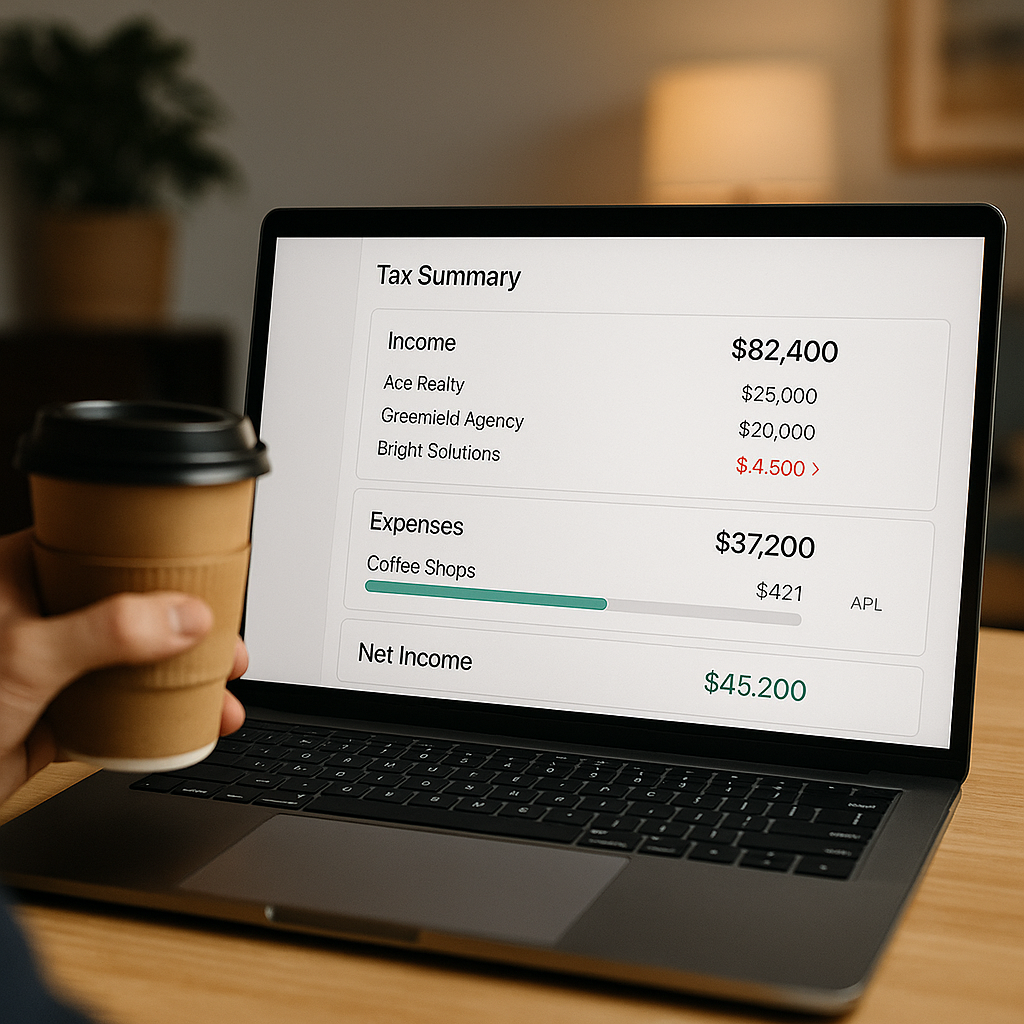
    A close-up of a laptop displaying a financial dashboard with income, expenses, and net income while a person holds a takeaway coffee cup, symbolizing a small business owner analyzing spending habits and business finances in a cozy workspace.
    That moment you realize your “small” coffee habit adds up faster than your clients pay — knowing your numbers means making smarter choices.

    Knowing your numbers doesn’t just help you file taxes; it helps you make better choices. I could finally see which clients paid late (and which ones I should gently fire). I could track where my money was going — those “harmless” $7 coffee runs were stacking up like bad karma.

    It’s funny how power shows up in small ways. I didn’t become a CPA overnight. But I did become the kind of business owner who could look at a spreadsheet without flinching.

    If you’re a freelancer, gig worker, or small business owner juggling everything from invoices to marketing, this part might hit home: understanding your numbers is freedom. It’s the difference between constantly reacting and finally taking the wheel.

    And trust me, after being ghosted by an accountant, the wheel never felt so good in my hands.

    What I Learned (So You Don’t Have To Panic Like I Did)

    1. Never outsource your understanding. Hire professionals, yes — but don’t hand over your power.
    2. Use simple tools. Platforms like Gestora.ca are designed for Canadians who want to keep things simple and affordable.
    3. Make it a weekly habit. Ten minutes every Friday reviewing your numbers beats ten hours of panic every April.
    4. Know that you’re not alone. Most of us didn’t start our businesses because we love bookkeeping. But getting organized isn’t just about taxes — it’s about peace of mind.

    The Moral of the Story

    When my accountant ghosted me, I thought it was a disaster. But looking back, it was probably the best thing that could’ve happened to my business. It forced me to take control, to see my finances not as a chore but as part of my craft.

    Now, every time I upload a receipt or balance my P&L, I feel something I never expected — confidence.

    So, to all the freelancers, micro-business owners, and gig workers reading this while staring at a mountain of receipts: don’t wait for someone else to save you from the chaos. You’ve got this.

    And if you ever find yourself typing “how to survive tax season without losing your mind” into Google, remember this story — and maybe check out Gestora.ca before your coffee gets cold.

  • The Blinking Cursor of Doom: How to Beat Content Creation Fatigue Without Burning Out

    The Blinking Cursor of Doom: How to Beat Content Creation Fatigue Without Burning Out

    It’s 2:00 PM on a Tuesday. You’ve got a lukewarm coffee on your desk (perhaps your third of the day), and you’re staring at it.

    The Empty White Page.

    It’s taunting you. That little vertical cursor just keeps blinking. Blink. Blink. Blink. It’s waiting for brilliance. It’s waiting for you to summarize your entire business expertise into a witty, engaging, SEO-optimized, 1000-word masterpiece that will miraculously bring in five new clients by sundown.

    And you? You’ve got nothing. Your brain feels like it’s stuck in a Montreal snowbank—spinning its wheels, making a lot of noise, but going absolutely nowhere.

    If this sounds familiar, welcome to the club. It’s not just you, and you’re certainly not failing. You’re experiencing content creation fatigue, and it is the silent killer of productivity for solopreneurs across Canada.

    The “Good Old Days” Weren’t That Long Ago

    Do you remember when “marketing” meant maybe putting an ad in the local paper, attending a Chamber of Commerce breakfast, or just doing such a good job that word-of-mouth kept you busy?

    “Content is King,” they said. It sounded simple enough. Write a blog post once a week. Share your thoughts.

    But somewhere along the line, the kingdom expanded, and now you’re expected to rule over all of it. Suddenly, you don’t just need a blog post. You need a LinkedIn article (professional tone, please), three clever Instagram captions (don’t forget the hashtags), a relatable TikTok video (hope you know the latest dance trend), and an email newsletter that people actually want to open.

    Oh, and you need to do all of this while actually running your business. You know, the thing that actually pays the bills?

    For the Canadian solopreneur—the corner store owner in Montreal, the graphic designer in Toronto, the realtor in Vancouver, the independent contractor in Halifax—this pressure is immense. You are the CEO, the CFO, the customer service rep, and now, the Chief Marketing Officer. It’s enough to make anyone want to close the laptop and head to the nearest rink for some stress relief.

    An overwhelmed multi-armed solopreneur woman juggling marketing, sales, phone calls, laptop, and calculator, representing small business burnout and content creation fatigue.
    The reality of the modern solopreneur: trying to be the CEO, CFO, and entire marketing department all at once.

    Why the “Empty Page” is So Heavy

    The biggest time-suck for a small business owner usually isn’t fulfilling client work. You’re good at that. That’s your zone of genius.

    The real time-suck is the paralysis of translation. It’s taking that genius in your head and translating it into five different languages for five different platforms.

    It feels heavy because it requires a completely different type of brainpower than your actual work. If you’ve spent four hours deep in client strategy or complex coding, switching gears to “cheery Instagram mode” can feel nearly impossible. Your creative battery is already drained.

    This fatigue leads to a dangerous cycle:

    1. Procrastination: You put off writing because it’s painful.
    2. Guilt: You see competitors posting and feel like you’re falling behind.
    3. Panic Posting: You finally force something out just to have something up, but it’s not your best work.
    4. Burnout: The effort yields little reward, and you feel even more tired.

    Work Smarter, Not Harder (The Canadian Way)

    We need to stop treating content creation like a daily chore and start treating it like a renewable resource. We need to be efficient—like insulating your house before winter really hits.

    Here is the core truth that will set you free: You don’t need 10 new ideas every week. You need ONE good idea, used 10 different ways.

    You are already an expert. The knowledge is there. Stop trying to reinvent the wheel every time you open LinkedIn.

    The “One Great Idea” Repurposing Method

    Let’s say you’re a landscape architect, and you have one great tip about winterizing gardens.

    1. The Core Piece (The Heavy Lift): Write one solid blog post about it. Just get it done. Don’t worry about it being perfect; just get the info down.
    2. The Newsletter: Take that blog post, shorten it by 50%, add a friendly “Hey there,” and boom—that’s your weekly email.
    3. LinkedIn: Extract the three most important bullet points. Post them as a text-only post with a strong opening line like, “Most people ruin their gardens in November. Here’s how to stop.”
    4. Instagram/Facebook: Take one striking sentence from your blog post, put it on a nice background in Canva, and post it as an image. Paste part of your blog into the caption.
    5. Video: Turn your webcam on for 60 seconds. “Hi everyone, I just wrote a blog about winterizing, but if you only do ONE thing this weekend, do this…”

    Suddenly, one idea just filled your content calendar for a week. You didn’t have to be brilliant five times. You just had to be brilliant once, and then smart about how you sliced it up.

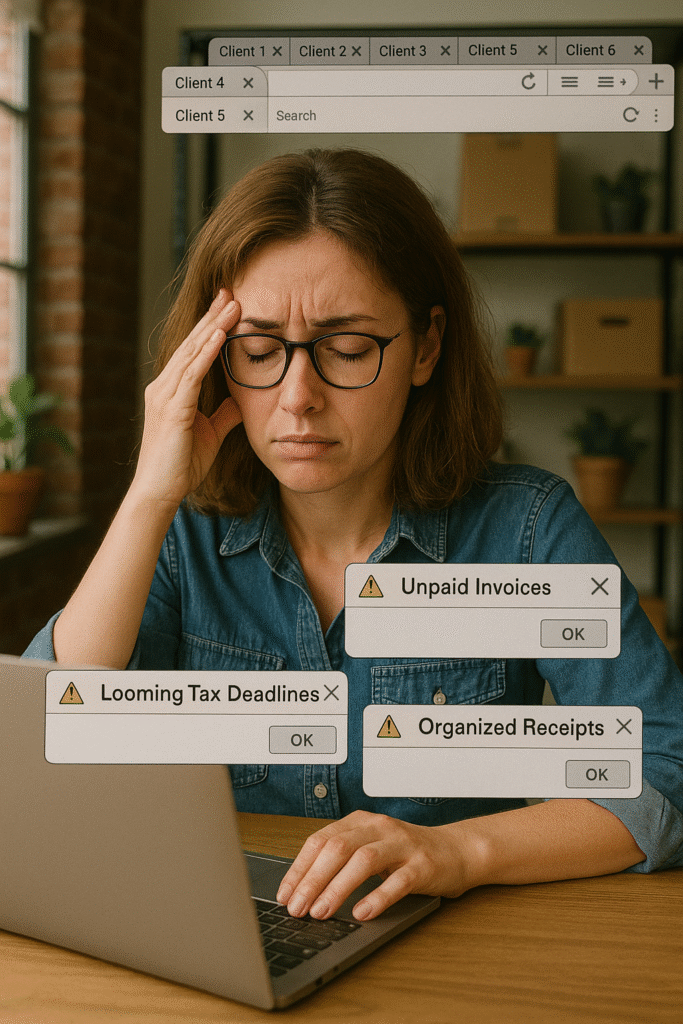
    A stressed small business owner in a denim shirt sitting at her desk with her hand on her temple, surrounded by digital browser tab overlays showing unpaid invoices, looming tax deadlines, and disorganized receipts, symbolizing mental overload and multitasking fatigue.
    Overwhelmed Entrepreneur – Mental Overload from Unpaid Invoices and Tax Deadlines – Gestora.ca

    Clearing the Mental Clutter

    Content fatigue often isn’t just about the content—it’s about bandwidth.

    Your brain is like a computer browser. If you have 50 tabs open—client work, unpaid invoices, unorganized receipts, looming tax deadlines—your processing speed for creativity is going to crawl to a halt.

    You cannot be creative when you are stressed about administration.

    If you’re sitting there staring at the blinking cursor, ask yourself: Is it really writer’s block? Or is it that your brain is secretly worrying about that shoebox of receipts you haven’t looked at since March?

    This is where the “solopreneur” mindset can sometimes hurt us. We think we have to do it all to be successful. But true success is knowing what only you can do, and getting help for the rest.

    Finding Your Relief Valve

    Imagine if you didn’t have to worry about the “backend” of your business.

    If you knew your bookkeeping was being handled, your receipts were organized, and you had a clear picture of your monthly profit without having to open a spreadsheet, how much mental energy would that free up?

    Probably enough to finally write that blog post.

    At Gestora, we see this every day. We don’t just see receipts; we see the stress they cause. Our goal isn’t just to balance your books; it’s to balance your business life. We handle the admin grunt work—and even offer smart, AI-powered tools to help with marketing tasks—so you can get back to your zone of genius.

    Sometimes, the best cure for writer’s block isn’t a writing course. It’s taking a completely different heavy task off your plate so you have room to breathe again.

  • The Freelancer’s Midnight Panic: How I Stopped Drowning in Admin Chaos

    The Freelancer’s Midnight Panic: How I Stopped Drowning in Admin Chaos

    The Freelancer’s Midnight Panic: How I Finally Escaped the 11:47 p.m. Spiral

    It was 11:47 p.m. on a Tuesday — that strange hour when your coffee is still warm, your to-do list is somehow longer than when you started, and your brain feels like a browser with 37 tabs open. I was sitting in my apartment in Montréal, squinting at Canva templates, trying to make an Instagram post for a client who wanted something “modern but retro, edgy but safe.” The kind of brief that makes you question both the laws of design and the existence of sleep.

    Somewhere between my fifth coffee and my third font change, I realized this wasn’t just a “me” problem. This was every freelancer I knew. We’re the ultimate Swiss Army knives — one day we’re accountants, the next we’re social media strategists, customer service reps, marketing directors, and occasionally, our own unpaid therapists. We wear every hat in the shop and then wonder why our necks hurt.

    The Life of a One-Person Department

    If you’ve ever juggled three clients, two invoices, and one existential crisis before breakfast, you know the drill. You promise yourself you’ll get organized. You buy a fancy planner, download the latest project management app, maybe even colour-code your Google Calendar. For a week, it feels like you’ve cracked the code. Then one late night, you find yourself deep in a rabbit hole of “free invoice templates,” wondering why the universe made bookkeeping sound so easy on YouTube.

    That was me. Living proof that you can be good at your craft and still lose half your billable hours chasing receipts, updating spreadsheets, or trying to remember if you sent that last invoice to the right “Jennifer.” (There are always at least three.)

    When the Hustle Becomes the Hamster Wheel

    At some point, freelancing stopped feeling like freedom and started feeling like a treadmill set just a bit too fast. I wasn’t building my dream — I was maintaining my exhaustion. The gig economy glorifies the grind, but no one talks about the 11:47 p.m. panic — that sinking feeling when you realize you’re your own boss, employee, accountant, and IT department.

    That’s when I decided to stop doing everything the hard way. I didn’t need to hustle harder; I needed to work smarter. Automating the boring stuff became my new obsession. I started small — setting up automatic invoice reminders, syncing my receipts to the cloud, and scheduling my posts in advance instead of in caffeine-fueled bursts of chaos.

    When Automation Feels Like Self-Care

    Here’s the funny part: the moment I stopped micromanaging every corner of my business, I actually started enjoying my work again. Automation didn’t steal my creativity — it protected it. Suddenly, I wasn’t waking up in cold sweats over unpaid invoices or scrambling to file expenses at tax time.

    Then came the real game-changer.

    One night, in my usual scroll-of-desperation, I stumbled upon Gestora.ca — a platform clearly built by people who know what 11:47 p.m. feels like. The kind of people who’ve stared at a pile of receipts and muttered, “There has to be a better way.” Turns out, there is.

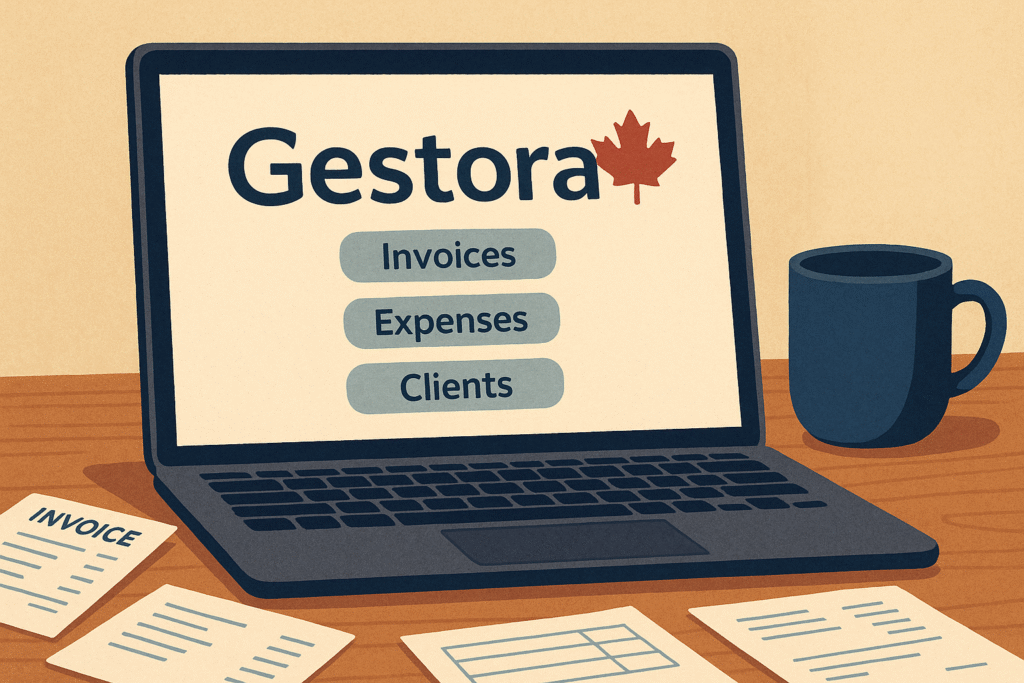
    Illustration of a laptop screen displaying the Gestora platform with options for invoices, expenses, and clients beside a blue coffee mug and scattered receipts on a wooden desk, symbolizing practical financial management for Canadian freelancers and small business owners.

    A Platform That Gets It

    Gestora wasn’t another shiny app shouting buzzwords about “optimization” or “synergy.” It was practical. Human. Canadian. The platform understood the messy middle of small business life — where you don’t have a finance department, just a growing list of clients and the constant hum of “Did I log that expense?” in the back of your head.

    For micro and small business owners, freelancers, gig workers, and self-employed pros, Gestora feels like having a quiet assistant who handles the admin chaos while you focus on what you actually love — your craft, your clients, your growth. It takes care of the unglamorous parts: coding receipts, organizing transactions, tracking income, and helping you see a clear profit and loss without needing a finance degree.

    It’s like finally hiring someone to sweep up your mental workspace — except they don’t need coffee breaks, and they never call in sick.

    The Moment the Panic Fades

    A few weeks in, I realized something wild: I hadn’t stayed up past midnight in days. My browser tabs were down to a reasonable dozen. My mornings were quiet again — not because I’d “made it,” but because I’d stopped trying to do it all myself.

    There’s a peace that comes with knowing your numbers are in order, your invoices are automatic, and your marketing isn’t living in a scattered spreadsheet. It’s like turning on cruise control after years of white-knuckling the steering wheel.

    I still work hard, but now it feels like I’m steering the ship instead of paddling with a spoon. And that 11:47 p.m. panic? Replaced with a deep, glorious sleep — the kind that only happens when your business finally runs smoother than your espresso machine.

    Final Thought

    If you’re a freelancer or small business owner burning both ends of the candle — stop and take a breath. You don’t need to be the whole company. You just need the right system behind you. Let the tech handle the grunt work so you can get back to doing what got you into business in the first place.

    Because freedom isn’t about working for yourself; it’s about finally feeling free while you do it.

    And if it’s already 11:47 p.m. while you’re reading this — close those tabs, my friend. Gestora’s got this one.