

It’s 2:00 PM on a Tuesday. You’ve got a lukewarm coffee on your desk (perhaps your third of the day), and you’re staring at it.
The Empty White Page.
It’s taunting you. That little vertical cursor just keeps blinking. Blink. Blink. Blink. It’s waiting for brilliance. It’s waiting for you to summarize your entire business expertise into a witty, engaging, SEO-optimized, 1000-word masterpiece that will miraculously bring in five new clients by sundown.
And you? You’ve got nothing. Your brain feels like it’s stuck in a Montreal snowbank—spinning its wheels, making a lot of noise, but going absolutely nowhere.
If this sounds familiar, welcome to the club. It’s not just you, and you’re certainly not failing. You’re experiencing content creation fatigue, and it is the silent killer of productivity for solopreneurs across Canada.
The “Good Old Days” Weren’t That Long Ago
Do you remember when “marketing” meant maybe putting an ad in the local paper, attending a Chamber of Commerce breakfast, or just doing such a good job that word-of-mouth kept you busy?
“Content is King,” they said. It sounded simple enough. Write a blog post once a week. Share your thoughts.
But somewhere along the line, the kingdom expanded, and now you’re expected to rule over all of it. Suddenly, you don’t just need a blog post. You need a LinkedIn article (professional tone, please), three clever Instagram captions (don’t forget the hashtags), a relatable TikTok video (hope you know the latest dance trend), and an email newsletter that people actually want to open.
Oh, and you need to do all of this while actually running your business. You know, the thing that actually pays the bills?
For the Canadian solopreneur—the corner store owner in Montreal, the graphic designer in Toronto, the realtor in Vancouver, the independent contractor in Halifax—this pressure is immense. You are the CEO, the CFO, the customer service rep, and now, the Chief Marketing Officer. It’s enough to make anyone want to close the laptop and head to the nearest rink for some stress relief.

Why the “Empty Page” is So Heavy
The biggest time-suck for a small business owner usually isn’t fulfilling client work. You’re good at that. That’s your zone of genius.
The real time-suck is the paralysis of translation. It’s taking that genius in your head and translating it into five different languages for five different platforms.
It feels heavy because it requires a completely different type of brainpower than your actual work. If you’ve spent four hours deep in client strategy or complex coding, switching gears to “cheery Instagram mode” can feel nearly impossible. Your creative battery is already drained.
This fatigue leads to a dangerous cycle:
- Procrastination: You put off writing because it’s painful.
- Guilt: You see competitors posting and feel like you’re falling behind.
- Panic Posting: You finally force something out just to have something up, but it’s not your best work.
- Burnout: The effort yields little reward, and you feel even more tired.
Work Smarter, Not Harder (The Canadian Way)
We need to stop treating content creation like a daily chore and start treating it like a renewable resource. We need to be efficient—like insulating your house before winter really hits.
Here is the core truth that will set you free: You don’t need 10 new ideas every week. You need ONE good idea, used 10 different ways.
You are already an expert. The knowledge is there. Stop trying to reinvent the wheel every time you open LinkedIn.
The “One Great Idea” Repurposing Method
Let’s say you’re a landscape architect, and you have one great tip about winterizing gardens.
- The Core Piece (The Heavy Lift): Write one solid blog post about it. Just get it done. Don’t worry about it being perfect; just get the info down.
- The Newsletter: Take that blog post, shorten it by 50%, add a friendly “Hey there,” and boom—that’s your weekly email.
- LinkedIn: Extract the three most important bullet points. Post them as a text-only post with a strong opening line like, “Most people ruin their gardens in November. Here’s how to stop.”
- Instagram/Facebook: Take one striking sentence from your blog post, put it on a nice background in Canva, and post it as an image. Paste part of your blog into the caption.
- Video: Turn your webcam on for 60 seconds. “Hi everyone, I just wrote a blog about winterizing, but if you only do ONE thing this weekend, do this…”
Suddenly, one idea just filled your content calendar for a week. You didn’t have to be brilliant five times. You just had to be brilliant once, and then smart about how you sliced it up.
Clearing the Mental Clutter
Content fatigue often isn’t just about the content—it’s about bandwidth.
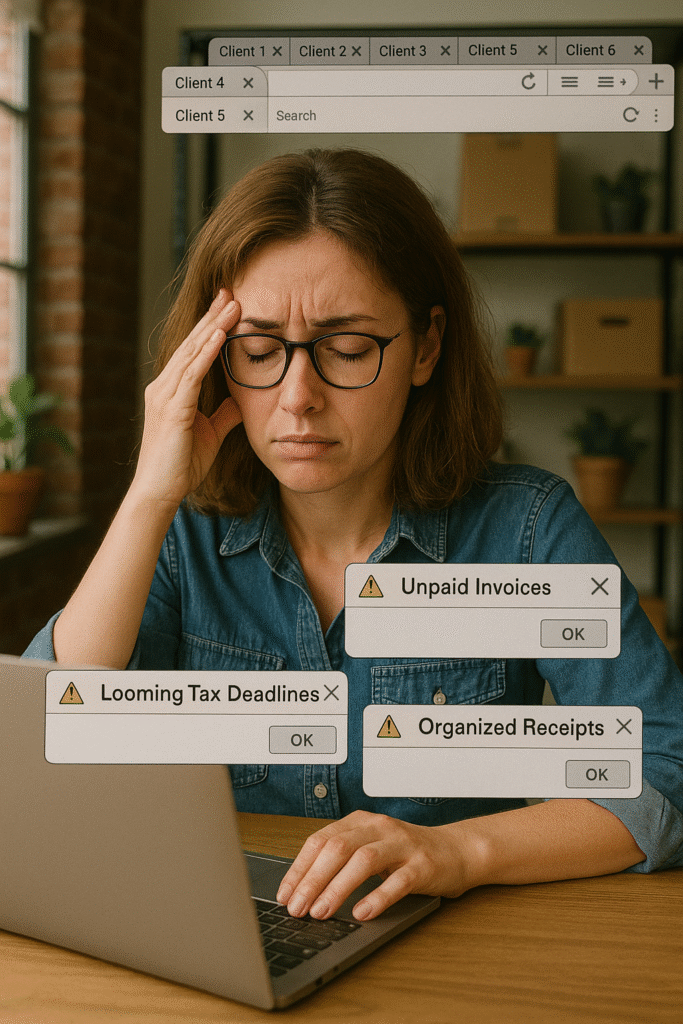
Your brain is like a computer browser. If you have 50 tabs open—client work, unpaid invoices, unorganized receipts, looming tax deadlines—your processing speed for creativity is going to crawl to a halt.
You cannot be creative when you are stressed about administration.
If you’re sitting there staring at the blinking cursor, ask yourself: Is it really writer’s block? Or is it that your brain is secretly worrying about that shoebox of receipts you haven’t looked at since March?
This is where the “solopreneur” mindset can sometimes hurt us. We think we have to do it all to be successful. But true success is knowing what only you can do, and getting help for the rest.
Finding Your Relief Valve
Imagine if you didn’t have to worry about the “backend” of your business.
If you knew your bookkeeping was being handled, your receipts were organized, and you had a clear picture of your monthly profit without having to open a spreadsheet, how much mental energy would that free up?
Probably enough to finally write that blog post.
At Gestora, we see this every day. We don’t just see receipts; we see the stress they cause. Our goal isn’t just to balance your books; it’s to balance your business life. We handle the admin grunt work—and even offer smart, AI-powered tools to help with marketing tasks—so you can get back to your zone of genius.
Sometimes, the best cure for writer’s block isn’t a writing course. It’s taking a completely different heavy task off your plate so you have room to breathe again.